








Your 48-Hour Survival Guide for Algorithm Updates

Why Panic is the Worst Strategy (And What To Do Instead)
It’s 3:17 AM. You’re staring at a dashboard lit by the cold glow of your laptop. The traffic graph, usually a gentle mountain range, looks like a cliff edge. A 40%, 60%, maybe 80% drop. Your stomach lurches. This isn’t a bad day; this is the algorithm update—the phantom menace every content creator fears.
Your first instinct is to panic. To frantically publish something, anything. To tweak every setting, email your list, post on every forum. This is what loses the war.
An algorithm change is not a personal attack. It’s a systems reset. Google, Meta, YouTube—these are vast, complex ecosystems trying to solve a simple problem: connecting a user’s query with the best possible answer. When they change the rules, they’re recalibrating their definition of “best.” Your sudden invisibility means the system’s new calculus doesn’t favor your current configuration. This is a systems problem, and it requires a systems response.
Panic leads to reactive, surface-level actions that often violate core platform principles: keyword-stuffing in a frenzy, deleting old posts in fear, or spamming social media with “Why aren’t you seeing my posts?!”—actions that can trigger further downranking.
The professional response is not emotionless, but it is procedural. It’s the digital equivalent of an airline pilot following a checklist when a warning light flashes. The goal of this guide is to be that checklist. In the next 48 hours, you will move from victim to investigator, from reactive to strategic. You will not recover all your traffic immediately—that’s a fantasy. You will, however, stabilize the situation, gather critical intelligence, and lay the groundwork for a smarter, more resilient recovery. This is damage control and reconnaissance, all in one.
This is just emergency response. For the long-term solution, read our complete 3-stream system Beyond the Algorithm: The 3-Stream System for Stable Creator Income
Table of Contents
The First Hour: Diagnose, Don’t Catastrophize
Stop. Close every social media tab and forum. Do not search for “latest Google update” and fall into the collective anxiety spiral. Your first hour is for calm, focused data collection.
Step 1: Confirm the Scope
Is this a site-wide collapse or a targeted strike?
- Check Google Analytics or Your Primary Tracker: Look at Acquisition > Overview. Is the drop across all channels (Organic, Direct, Social) or just one? A platform-wide algorithmic hit primarily crushes Organic Search. If Direct and Social are also down, you may have a technical issue (e.g., site crash, broken tracking code).
- Check Google Search Console: This is your mission control. Navigate to the Search Results report. Note the date of the steep drop. Then, go to the Search Traffic > Manual Actions report. A “No issues detected” message here is good news—it means you haven’t been manually penalized. This is likely an algorithmic adjustment.
Table 1: Initial Triage Checklist
| Symptom | Likely Cause | Immediate Action |
|---|---|---|
| Sharp drop in Organic Search only | Core/Helpful Content Update | Proceed with this guide. |
| Drop across all traffic channels | Technical site issue | Check site uptime (UptimeRobot), hosting status, and core web vitals. |
| Drop in specific page categories | Topic-specific authority devaluation | Identify the common theme of affected pages. |
| Traffic flatlines to zero | Manual penalty or site deindexing | Urgently check Search Console Manual Actions. |
Step 2: Identify the Casualties
In Search Console, use the Performance report. Set the date range to 28 days and compare the last 14 days with the previous 14. Click on Pages.
Which pages were hit hardest? Don’t just look at the biggest percentage drops—look at the pages that lost the most absolute traffic. These are your high-value assets. Export this list. You’re not fixing them now; you’re identifying the battlefield.
The Mental Shift: You are no longer a creator whose work was rejected. You are a detective with a crime scene. Your first task is to survey the scene and note the evidence.
Hours 2-12: The Triage Protocol
With the initial shock absorbed and data in hand, your next 12 hours are for intelligent triage. You will not rewrite 50 articles. You will perform strategic first aid on the most critical patients and gather more intel.
Triage Action 1: The “Quick Win” Content Audit
Take your list of top 5 most-affected high-traffic pages. For each, ask these three questions—the EEA Triage (Experience, Expertise, Authoritativeness, Trustworthiness):
- Experience: Does this page clearly demonstrate first-hand, practical experience with the topic? Or is it a surface-level summary?
- Expertise: Is the depth of knowledge evident? Are terms explained correctly? Is it better than a ChatGPT summary?
- Helpfulness: Is the page structured to solve a problem as efficiently as possible? Is there unnecessary fluff or “click-baity” structure?
Often, pages hit by a “Helpful Content Update” fail one of these. Your action here is not a full rewrite, but a “tactical enhancement.” Can you:
- Add a short, authentic personal anecdote at the top (Experience)?
- Insert a clarifying definition or a small, advanced tip (Expertise)?
- Move a key solution higher up or add a bulleted summary (Helpfulness)?
Make these focused edits. The goal is to send a signal of improved quality.
Triage Action 2: The Competitive Forensics Report
For one of your top affected pages, search its primary keyword. Who is now ranking above you?
- Analyze the top 3 results. What do they have that yours lacks?
- Format: Are they ultimate guides, lists, video-based?
- Depth: Are they 2x longer? Do they include more original data?
- Freshness: Are their dates more recent?
- Presentation: Do they have better tables, diagrams, or embedded tools?
Table 2: Competitive Gap Analysis Framework
| Factor | Your Page (Pre-Update) | New #1 Result | Strategic Insight |
|---|---|---|---|
| Word Count / Depth | 1,200 words | 3,500 words | The new algorithm may favor comprehensive coverage. |
| Content Type | Standard blog post | “Ultimate Guide” with PDF | Guides may be favored over opinion pieces. |
| Media | 2 images | 1 video, 3 custom charts | Multimedia, especially video, may be a stronger signal. |
| Date Published | 8 months ago | Updated 3 weeks ago | Freshness may be more critical. |
This isn’t about copying. It’s about understanding the new “quality” signals the algorithm is rewarding.
Triage Action 3: The Platform Pulse Check
Spend 30 minutes in reputable SEO news sources (e.g., Search Engine Land, Google’s Search Liaison on Twitter). Is a confirmed update rolling out? What’s the early chatter from trusted analysts? Avoid the outrage echo chambers. Look for pattern recognition: “E-commerce sites hit hard,” “Thin affiliate content targeted,” “Video integration seems boosted.” This gives you the macro context for your micro situation.
By hour 12, you should have: 1) Enhanced a few key pages, 2) Understood your new competitive landscape, and 3) Have a hypothesis about the update’s intent. Now, sleep. The reactive phase is over.
Day 2: Strategic Audits and Action
With a night’s distance, you move from triage to strategy. Day 2 is about building your recovery plan.
Audit 1: Topical Authority Mapping
Algorithms increasingly rank entities and topics, not just pages. Use a tool like Google Search Console or a simple spreadsheet.
- List all your significantly affected pages.
- What core topic does each belong to? (e.g., “meal prep for beginners,” “Python error handling,” “budget travel in Japan”).
- Group your pages by these topics.
You may discover that all your pages on “meal prep” were hit, but your pages on “kitchen gadgets” were not. This suggests the algorithm has devalued your authority on that specific topic cluster. Your site’s overall “meal prep” entity score may have dropped.
The Action: Your long-term plan must include strengthening that entire topic cluster—not just fixing individual pages. This means creating new, deeper content within that cluster and improving internal linking between those pieces.
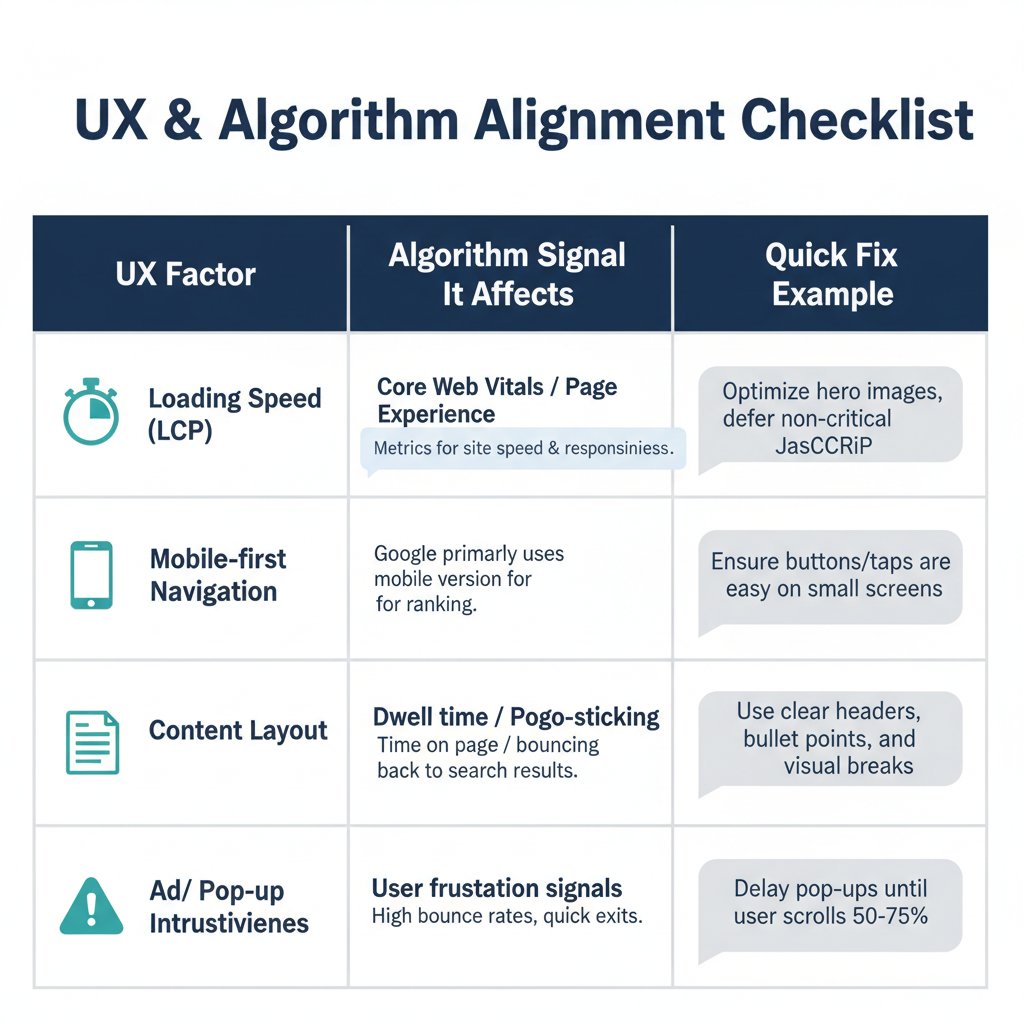
Audit 2: The User Experience (UX) Health Check
Algorithm updates are increasingly proxies for user satisfaction. Run a brutal audit:
- Page Speed: Use Google PageSpeed Insights. Are your affected pages slow? A core update often ties closely with Core Web Vitals.
- Intrusive Interstitials: Do pop-up email signups block content immediately?
- Readability: Is the text dense and unbroken? Is the language overly complex?
- Mobile Experience: Is navigation on a phone frustrating?
Table 3: UX & Algorithm Alignment Checklist
Building Your 30-Day Recovery Plan
Your 48-hour survival period ends with a plan, not a solution.
- Weeks 1-2 (Stabilize): Complete the EEAT enhancements for your top 10 affected pages. Fix any critical technical UX issues (speed, mobile errors).
- Weeks 3-4 (Strengthen): Choose your weakest topic cluster (from Audit 1). Create one definitive, “10x” piece of content for that cluster—something better than anything you saw in your competitive analysis.
- Month 2 (Expand): Promote this new cornerstone content. Use it as a hub to re-link and revitalize your older, affected pages within that cluster.
Remember: Recovery is not linear. You may not see positive movement for weeks. The goal is to systematically address the weaknesses the algorithm revealed.
Key Takeaways: Your Permanent Response Blueprint
- Panic is a Tax on Intelligence. It clouds judgment and leads to harmful, reactive decisions. Institute a personal protocol: See drop → Open diagnostics checklist → Breathe.
- You Are Fighting a System, Not a Person. Algorithm updates are changes to a quality-evaluation system. Your job is to reverse-engineer the new quality parameters, not to plead with an oracle.
- The 48-Hour Rule is Sacred. Hour 1: Diagnose. Hours 2-12: Triage. Day 2: Audit & Plan. This structure prevents chaos.
- Data Beats Opinion. Your gut feeling about “why” is worthless without data from Search Console, analytics, and competitive analysis.
- Updates Reveal Weaknesses That Were Already There. The algorithm didn’t break your site; it exposed where your site was already fragile—be it thin content, poor UX, or shaky topical authority.
Common Mistakes That Make the Damage Worse
- The Publishing Frenzy: Flooding your site with new, panicked content signals low-quality, automated behavior.
- The Mass Deletion: Deleting old pages destroys whatever residual traffic and backlink equity they hold. Redirect or improve, never delete in fear.
- The Plea Post: Publicly begging your audience for engagement (“The algorithm is hiding me!”) looks unprofessional and can be seen as manipulative by platforms.
- Chasing the Last Update: Optimizing for what was rewarded, not analyzing what is now being rewarded.
- Ignoring the Long Game: Abandoning your core content strategy for quick fixes, thus making your site’s focus even murkier.
The Future of Algorithm Volatility
Expect the tremors to continue, but their nature will change. The trend is away from simple keyword matching and towards multifaceted intent understanding. Future updates will likely:
- Deepen EEAT Integration: Weighting firsthand experience and credentialed expertise even more heavily.
- Incorporate AI Evaluation: Using LLMs (Large Language Models) to directly assess content quality, helpfulness, and originality.
- Favor Multi-Format Answers: Systems that can seamlessly integrate text, video, and interactive elements to answer a query may be prioritized.
- Increase Personalization (Carefully): While core relevancy remains global, slight personalization based on user interaction history may play a larger role.
The implication is clear: the bar for “quality” is being raised by AI, for AI. Your content must satisfy both a human seeking understanding and a machine evaluating semantic depth and utility.
Final Editorial Reflection: Building Calm in the Chaos
I have sat where you are, in the blue glow of a bad dashboard. The fear is not of lost revenue alone, but of irrelevance—that the digital ground you built upon has simply dissolved.
What I’ve learned is this: algorithm updates are the seasons of the digital world. They are not disasters, but cycles of die-back and regrowth. The sites that thrive are not those with magical SEO tricks, but those with deep roots: a genuine understanding of their audience, a commitment to utility over virality, and the operational calm to treat a crisis as a diagnostic.
This 48-hour guide is not a hack. It is a discipline. It is the practice of replacing fear with procedure. By following it, you do more than salvage traffic; you train yourself to be the kind of builder who is not easily undone by a change in the weather. You build not for the algorithm of today, but for the timeless principle that useful, thoughtful, human work finds its audience, one way or another.
Let this panic be the last one that catches you unprepared. From now on, you have a protocol.
Frequently Asked Questions
Q1: How long does it typically take to recover from a major algorithm update?
A: There’s no standard timeline. Recovery can take weeks to 6+ months, depending on the severity of the hit and the quality/completeness of your fixes. The key is to focus on systematic improvement, not daily traffic fluctuations.
Q2: Should I disavow backlinks if my site is hit by an update?
A: Not as a knee-jerk reaction. A broad core update is rarely about “toxic links.” Only disavow if you have a manual action specifically citing bad backlinks. Random disavowing can harm your profile.
Q3: Does updating the “last modified” date on my posts help?
A: Simply changing the date without substantial content updates is a shallow tactic. If you make meaningful EEAT enhancements (adding experience, expertise, helpfulness), then updating the date can signal freshness. The update must be substantive.
Q4: If my site is hit, should I move to a new domain?
A: Almost never. This is a nuclear option that discards all your domain authority, backlinks, and brand recognition. It is far better to diagnose and fix the issues on your existing, established domain.
Q5: How can I tell if it’s a “Helpful Content Update” versus a “Core Update”?
A: Google sometimes names updates (like the “Helpful Content Update”). A “Core Update” is broader. Practically, the response is identical: a rigorous audit of content quality, user experience, and topical expertise. Don’t get caught up in the label; focus on the weaknesses revealed.
Q6: Is buying links or social signals a good way to recover quickly?
A: No. This is extremely high-risk. Inorganic, spammy signals are easily detected and can lead to manual penalties, making your situation permanently worse. Recovery must be built on genuine quality improvements.
Q7: Will publishing more frequently help me recover faster?
A: Not if it sacrifices quality. Publishing thin, rushed content to “show activity” signals low quality to the algorithm. It’s better to publish one exceptional, deeply-researched piece that demonstrates E-E-A-T than five shallow posts.
Q8: How important are technical SEO fixes (like Core Web Vitals) for recovery?
A: Critically important. Core Updates directly incorporate page experience signals. If your site is slow, unstable, or hard to use on mobile, fixing these is not optional—it’s foundational. They are the table stakes for being considered “helpful.”
Q9: Should I switch my content focus entirely based on what survived the update?
A: Not entirely. Use the data to refine and deepen, not to pivot erratically. If your “how-to” guides survived but your “opinion” pieces died, double down on utility. A drastic, reactive pivot confuses your site’s topical authority.
Q10: Can I pay someone to “fix” my site after an update?
A: Be very cautious. Many “recovery services” are predatory. No one can guarantee recovery. A legitimate professional will not promise quick fixes but will offer a detailed audit and a plan based on the principles in this guide—focusing on content and UX quality.
