




Digital Sharecropping: How Platforms Keep You Poor and Dependent in 2026

The Farm You Don’t Own: Defining Digital Sharecropping
You plant seeds—hours of writing, filming, editing, engaging. You tend the crop—analyzing metrics, adapting to trends, nurturing a community. You even see a harvest—views, likes, followers, perhaps some ad revenue. The land feels like yours. The connection with your audience feels genuine. But with one opaque policy change, one algorithmic shift, the harvest can vanish.
The connection can be severed. You are left with nothing but the sweat of your labor, while the owner of the land—the platform—simply recalibrates its machinery for the next season.
This is Digital Sharecropping. It is the predominant economic model of the modern creator economy, and understanding it is the first step toward true professional sovereignty.
The term “sharecropping” originates from post-Civil War Southern US agriculture. Landless farmers would work a plot owned by a landlord, paying with a large share of their crop.
They bore all the risks of labor and weather, while the landlord owned the only asset that truly mattered: the land itself. The farmer could never build equity and could be evicted at the landlord’s whim.
Digital Sharecropping operates on the same principle:
- The Landlord: The platform (Instagram, YouTube, TikTok, Facebook, Medium, Substack, even Amazon KDP).
- The Land: The platform’s infrastructure, distribution network, and audience attention.
- The Sharecropper: You, the creator.
- The Crop: Your content, your community, your creative labor.
- The Rent: Your data, your audience’s attention, a percentage of your revenue, and most importantly, your strategic dependence.
Your creative effort builds value, but that value accrues primarily to the platform’s ecosystem, not to an asset you own and control. You are a tenant, not a landowner. This article will dissect this hidden architecture of dependence, trace its historical roots, and provide a blueprint for how you can transition from a digital sharecropper to a freeholder—a sovereign owner of your own digital assets.
From Cotton to Content: A Brief History of Sharecropping Economics
To see the future of digital work, we must look at the past of physical labor. The agrarian sharecropping system was a “solution” to a problem of capital and labor. After the abolition of slavery, landowners had land but no labor force. Freed slaves and poor whites had labor but no land. Sharecropping emerged as a compromise: work the land, pay with a share of the crop.
It was a trap masquerading as an opportunity. The sharecropper was perpetually in debt to the “company store” (owned by the landlord) for seeds and tools. The accounting was controlled by the landlord. Bad weather or falling prices meant the sharecropper owed more, sinking deeper into peonage. There was no path to ownership.
Table 1: Agrarian vs. Digital Sharecropping – A Structural Comparison
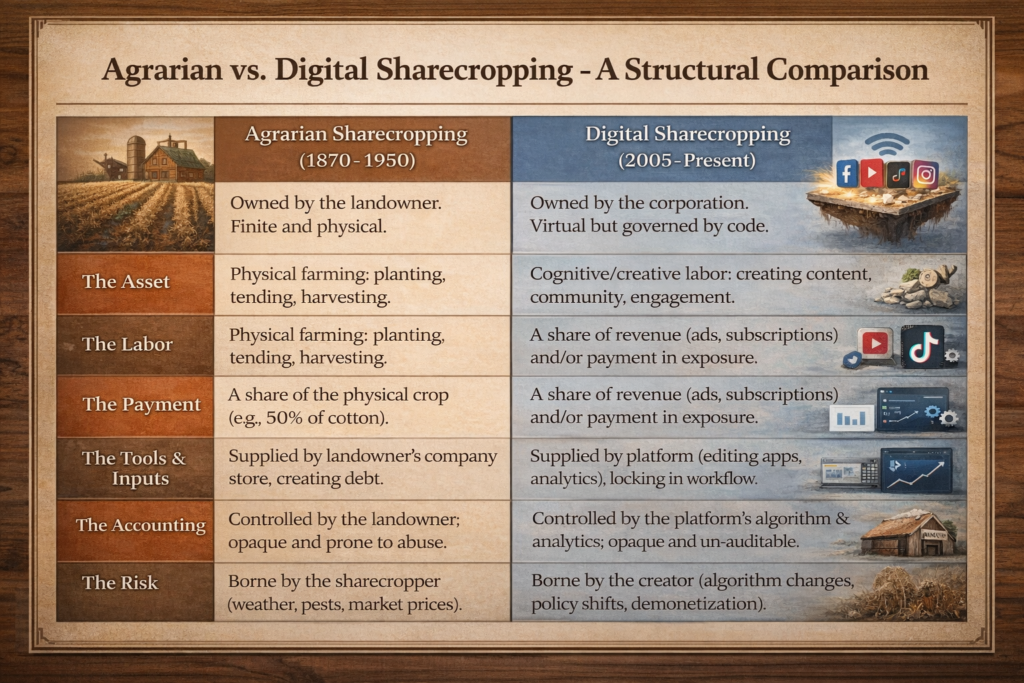
The parallel is not a perfect metaphor, but it is a powerful mental model. The core injustice is identical: the separation of labor from asset ownership. You do the work that makes the asset valuable, but you have no claim on the asset itself. Your efforts increase the platform’s network effect—its real estate becomes more valuable because you and others are building on it—but your lease can be terminated without recourse.
The Modern Plantation: How Platforms Structure Dependence?
Platforms are not evil by design; they are brilliant by design. Their business model requires massive, engaged user bases to sell to advertisers or to create network effects that lock in users. Creators are not the customers; they are the product, the engine of engagement. The architecture of these platforms is meticulously built to encourage maximum labor (content creation) while minimizing the laborer’s power. This happens through three layers:
Layer 1: The Interface of Addiction. Endless scrolls, variable rewards (likes, comments), notifications, and ranking systems (follower counts, view counters) are designed to trigger dopamine loops. They keep you, the creator, hooked on the metrics of validation, mistaking platform engagement for business progress.
Layer 2: The Illusion of Ownership. You are given a “Profile.” You have “Followers.” You build a “Community.” The language implies sovereignty, but you control none of the underlying infrastructure. You cannot export your follower graph with meaningful connection data. You cannot take your community to a different town square. The platform owns the social graph you painstakingly built.
Layer 3: The Opaque Authority. The algorithm is the ultimate, unappealable authority. It is the weather, the landlord, and the judge. Its logic is a trade secret. Changes are announced retroactively, if at all. This creates a permanent state of anxiety and reactive labor, as seen in our previous article on the “Your 48-Hour Survival Guide.”
The Three Mechanisms of Value Extraction
Platforms extract value from creator labor in ways more subtle than just taking a revenue split.
1. Data Serfdom: Every interaction—every like, share, watch time, scroll depth—is data. This data trains the platform’s AI, improves its ad targeting, and makes it more indispensable to real customers (advertisers). Your labor generates the behavioral data that is the platform’s most valuable asset. You are unpaid data trainers.
2. Attention Harvesting: Your content is bait for human attention. The platform aggregates that attention and sells it in bulk. You might get a small cut of the ad revenue, but the primary value—the aggregated attention of a demographic—is captured by the platform. You are a sharecropper of consciousness.
3. Innovation Capture: Any new format, trend, or community behavior that emerges from creators is swiftly standardized, automated, and integrated into the platform’s toolkit. The organic, authentic innovation of the users is co-opted, sterilized, and turned into a feature that further locks in the platform’s dominance. Think of how Instagram Stories copied Snapchat, or how every platform now has “Reels” or “Short Videos.”
Table 2: The Value Flow in Digital Sharecropping
| What You Create (The Crop) | What the Platform Harvests (The Rent) | What You’re Left With |
|---|---|---|
| Engaging video content | User attention data, increased platform stickiness, ad revenue share | A temporary audience, fleeting relevance |
| A lively comment community | Social graph data, network effect strength, engagement metrics | Moderate influence, no direct contact list |
| A viral trend or new format | Innovation to copy, proof of market fit for new features | Credibility as a trendsetter, no IP ownership |
| Personal brand & trust | Authenticity to legitimize the platform’s ecosystem | Brand recognition, but hosted on rented land |
Case in Point: Algorithm Changes as the New Drought
Recall the panic of an algorithm update. In the sharecropping model, this is the economic equivalent of a drought or a sudden change in the landlord’s accounting rules. Your labor is the same. Your crop is the same. But the system dictating its value has changed, and your share plummets.
The platform’s imperative is not your prosperity; it is its own growth and sustainability. If the platform decides short-form video drives more overall user time than long-form essays, it will re-allocate “rain” (distribution) accordingly. You, the long-form essayist, did nothing wrong. You are simply farming the wrong crop on land where the climate control is owned by someone else with different priorities.
This is the fundamental insecurity of sharecropping: your business model is subject to the externalities of another entity’s business model. Your security is an illusion.
Breaking the Cycle: From Sharecropper to Freeholder
The solution is not to abandon platforms—they are incredible tools for discovery and reach. The solution is to change your relationship to them. Stop being a sharecropper and start becoming a freeholder—someone who owns their own productive asset. This is the essence of the Owned Asset Strategy.
Step 1: Identify Your Ownable Assets.
What can you truly own? Not a follower list, but an email list. Not YouTube views, but a website with SEO authority. Not TikTok fame, but a digital product (course, ebook, software) sold from your own store. Not platform-specific content, but deep, evergreen expertise documented in your own name.
Step 2: Use the Plantation as a Feed Lot.
Re-frame platforms. They are not your home; they are feed lots for your owned assets. Use Instagram to drive traffic to your blog. Use YouTube to build authority that sells your course. Use Twitter to grow your newsletter list. The goal of every action on a platform should be to lure valuable “livestock” (attention, trust) back to your own fenced land—your website, your email server.
Step 3: Build Your Three-Legged Stool.
A one-legged stool falls over. A diversified sovereignty stands. Build three core owned assets:
- A Sovereign Communication Channel: An email newsletter (using a service like ConvertKit or Beehiiv where you own the list). This is your digital deed to your audience.
- A Sovereign Knowledge Base: Your website/blog, optimized for search (SEO). This is your permanent, indexable, linkable asset.
- A Sovereign Product Engine: A way to monetize that doesn’t rely on platform ad revenue—a digital product, a membership, consulting. This is your independent economy.
Table 3: The Sharecropper vs. The Freeholder Mindset
| Scenario | The Sharecropper’s Reaction | The Freeholder’s Reaction |
|---|---|---|
| Algorithm change cuts reach by 70%. | Panic. Plead with the algorithm. Frantically change content. | Analyze. Redirect energy to SEO and email content. Leverage owned channels. |
| A new, hotter platform emerges. | Abandon current community to start from zero on the new platform. | Experiment on the new platform with the explicit goal of funneling users to owned assets. |
| Planning a product launch. | Announce it only on the platform, hoping the algorithm shows it. | Launch primarily to email list and website, using platforms for supplemental buzz. |
Key Takeaways: Your Declaration of Digital Independence
- If You Don’t Own the Asset, You Are the Product. The fundamental question for any creative endeavor is: “What asset am I building equity in?” If the answer is a platform profile, you are in a precarious position.
- Platforms are Tools, Not Homes. They are for discovery and reach, not for sovereignty. Use them with clear, extraction-oriented intent.
- The Algorithm is the Landlord. It controls the climate of your rented field. You cannot control it; you can only diversify away from total dependence on it.
- Your Email List is Your Deed. It is the closest thing to an ownable, portable, direct line to your audience. Prioritize it above all platform metrics.
- Revenue Follows Ownership. True wealth and security in the digital economy are built by owning the asset that generates value, not just by laboring on someone else’s.
Common Mistakes: Reinforcing Your Own Dependence
- Chasing Algorithmic Ghosts: Constantly reshaping your core content to fit every platform tweak, thereby having no coherent, ownable niche.
- Treating Followers as an Asset: Celebrating follower count while neglecting to convert them into email subscribers or website visitors.
- The Single-Platform Empire: Building an entire business—income, audience, identity—on one platform (e.g., “I’m a TikTok chef”).
- Neglecting SEO: Because platform distribution feels easier and faster, failing to build the slow, enduring asset of search traffic.
- Monetizing Only Through Platforms: Relying solely on platform ad revenue, YouTube Partner Program, or TikTok Creator Fund, which are the most revocable forms of income.
Future Outlook: The Coming Enclosure of the Digital Commons
The trajectory is towards greater extraction, not less. We are entering a phase of Digital Enclosure, mirroring the historical Enclosure Acts where common lands were fenced off for private profit.
- Pay-to-Play Distribution: Organic reach will continue to decline, pushing creators toward paid boosting.
- Platform-Specific Labor: Tools will become more integrated, making it harder to create content outside the platform’s ecosystem and port it elsewhere (e.g., proprietary video formats, live tools).
- AI-Generated Sharecroppers: Platforms may begin to compete with you using AI-generated content, further devaluing human creative labor on their own terrain.
The imperative for ownership will only become more urgent. The platforms will enclose the commons; your job is to have built your own private, fertile land elsewhere.
Final Editorial Reflection: On Building Your Own Soil
Sharecropping is a seductive trap because the land is already fertile. The platform offers tilled soil, irrigation, and a market nearby. Starting your own farm means clearing rocks, digging wells, and waiting years for trees to bear fruit. It’s harder, slower, and lonelier work.
But it is yours.
The platform’s soil can be salted by a policy change. Your well, once dug, provides water in every season. The equity you build in your own domain compounds. The relationship with an audience that chooses to visit your homestead, to subscribe to your papers, is fundamentally different—and more valuable—than one built on the fleeting convenience of a scroll.
This isn’t a call for a Luddite retreat. It’s a call for strategic duality. Be a brilliant, opportunistic hunter on the platform’s fertile lands. But be a stubborn, patient builder on your own plot. Channel the calories you gain from hunting into the permanent infrastructure of farming.
Stop celebrating the size of your harvest on rented land. Start measuring the depth of your own soil, the strength of your own fences, and the independence of your own water supply. That is the work that endures.
Frequently Asked Questions:
Q1: Isn’t it impossible to avoid platform dependence in today’s world?
A: The goal isn’t to avoid platforms completely—that’s impractical. The goal is to avoid total dependence. The shift is from “This platform is my business” to “This platform is a marketing channel for my business, which is built on owned assets.”
Q2: What’s the single most important owned asset I should build first?
A: An email list. It is portable, direct, and owned. It is your insurance policy against any platform change. Your website is a close second, as it’s your ownable, indexable real estate.
Q3: Are platforms like Substack or Ghost “owned” assets?
A: They are a hybrid. You own your email list and content, but you are still dependent on their infrastructure and deliverability. They are a much better model than pure social platforms, but self-hosting your blog and using a dedicated email service provider (ESP) is the pinnacle of ownership.
Q4: How do I start building an email list if my platform doesn’t allow links in bios/posts easily?
A: Get creative. Use link-in-bio tools (like Linktree) that centralize a link to your newsletter signup. Mention your newsletter explicitly in your content. Run occasional promotions or offer exclusive content available only via email. It’s a slower grind, but it’s foundational.
Q5: Is digital sharecropping inherently exploitative?
A: Absolutely. In fact, it’s more critical for small creators. A large creator might survive a platform shift due to sheer mass. A small creator with a 1,000-person email list and a niche website has a more resilient, focused, and monetizable asset than a small creator with 100k followers on a single platform.
Q7: Doesn’t this “owned asset” approach take much longer to show results?
A: Yes, initially. Platform growth can be viral and fast. Owned asset growth (like SEO and email) is typically linear and slow. But platform growth can disappear overnight. Owned asset growth compounds and persists. You are trading short-term spikes for long-term security.
Q8: What about platforms that pay creators directly, like the YouTube Partner Program? Isn’t that fair?
A: It’s a revenue share, which is fairer than just taking data. But it’s still sharecropping. You are being paid for your labor on their land, subject to their changing payout terms and demonetization rules. It is a cash crop, not land ownership.
Q9: How does the rise of AI content affect digital sharecropping?
A: It intensifies it. If platforms can flood their own ecosystems with “good enough” AI-generated content to keep users engaged, the bargaining power of human creators diminishes. Your unique value must become deeper (true experience, unique insights) and be anchored to your owned assets where you are the irreplaceable authority.
Q10: Is this just fear-mongering? Platforms have made many people successful.
A: They have. And many sharecroppers in the 1920s had their best years ever before the drought or the boll weevil hit. This is not fear-mongering; it is risk assessment. Platforms have also destroyed livelihoods overnight through opaque changes. Success on a platform is real, but it is a success built on a foundation you do not control. Prudence dictates building a foundation you do.
