







Most Important Investment Methods for 2026 – Practical Guide for Long-Term Wealth
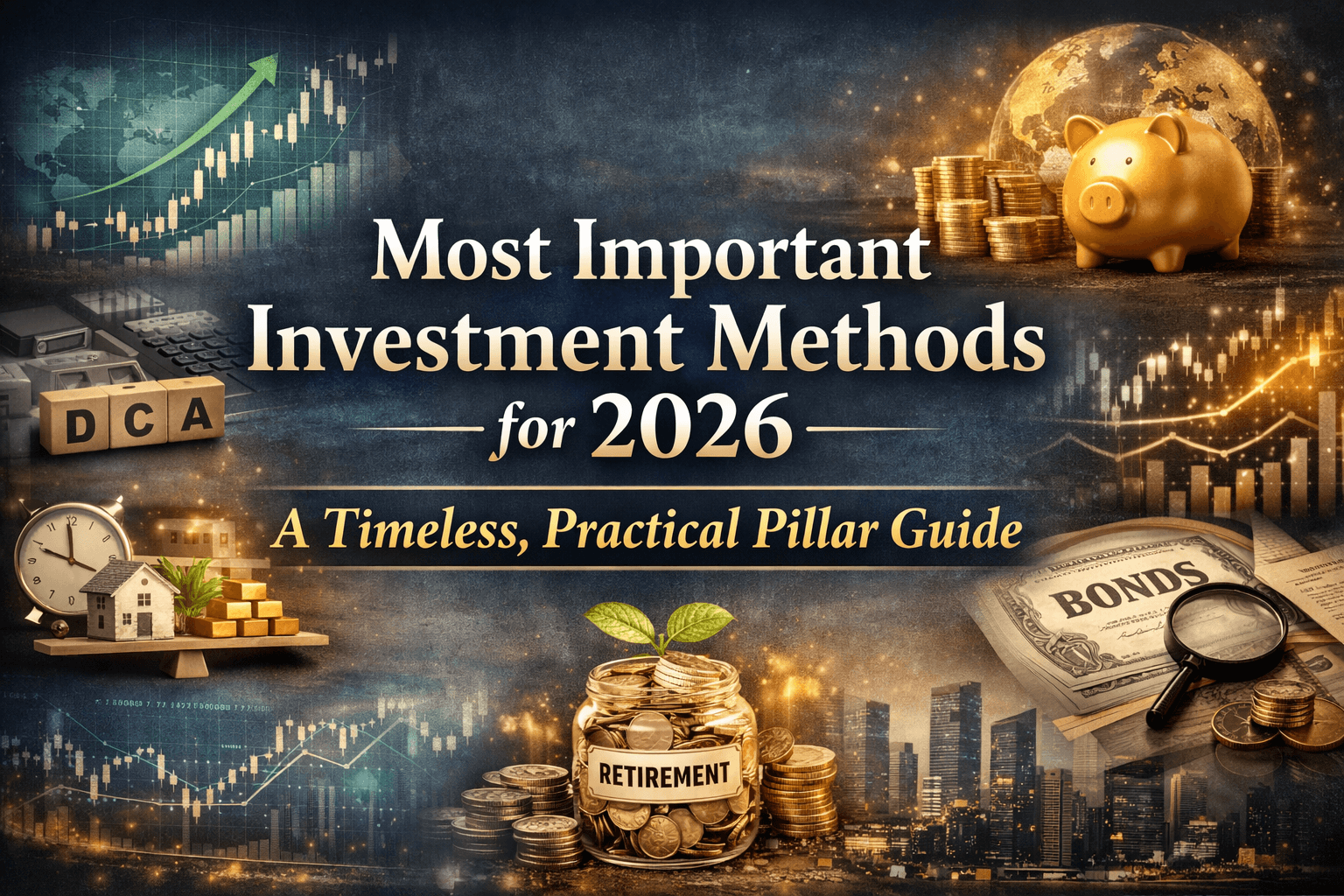
Why 2026 Requires Timeless Investment Thinking?
Every decade brings new financial narratives. One year it is technology, another year it is commodities, then real estate, then something entirely new. By 2026, markets will look different again. Interest rates change. New industries dominate headlines. Yet beneath all this change, the core mechanics of successful investing stay the same.
The biggest mistake investors make is believing that new times need new rules. In reality, new times punish weak fundamentals and reward disciplined systems even more aggressively.
This pillar guide explains the most important investment methods for 2026. It focuses on principles that have survived multiple market cycles. These approaches are not dependent on geography, specific tax laws, or temporary trends. They are based on how money grows, how risk behaves, and how human psychology interacts with markets.
Whether you are starting from zero or refining an existing portfolio, this guide will help you understand what actually works. It will explain why it works. You will learn how to apply it calmly and consistently.
For a deep dive into how fees, taxes, and small decisions quietly erode wealth, read our detailed guide here. https://redlists.org/small-decisions-quietly-destroy-long-term-wealth/
Table of Contents
Section 1: The Core Philosophy Behind All Successful Investing
Before we talk about where to invest, let’s agree on how investing really works. Over the years, I have managed portfolios. I have observed one truth that holds steady. Philosophy drives outcomes more than any single stock pick.
1. Investing Is the Management of Uncertainty, Not Prediction
Let me be blunt: No one knows what the market will do tomorrow. Anyone who claims otherwise is selling hope, not advice. Markets aren’t puzzles to be solved—they’re risks to be managed.
I’ve watched brilliant analysts get crushed by black swan events and humble investors thrive through simple preparation. The difference? The successful ones stopped trying to predict the future and started building portfolios that could withstand multiple futures.
That’s why timeless approaches don’t rely on forecasts. They rely on probabilities, diversification, and consistent exposure to growth. Your goal isn’t to be right about next quarter—it’s to be positioned for the next decade.
2. Time Is a More Powerful Factor Than Intelligence
Here’s a humbling truth I share with every new client: A disciplined amateur has the potential to outperform. This is particularly true over a 30-year horizon. An undisciplined genius often can-not match this level of success. A disciplined amateur with a long-term vision is usually more successful. Even a genius may not achieve the same results without discipline.
Compounding isn’t a mathematical trick—it’s a force of nature. But it demands one non-negotiable ingredient: time. You cannot substitute intelligence, research, or clever timing for the relentless multiplication that only years can provide.
I’ve seen this play out repeatedly: The investor who consistently contributes to their index funds, ignores the noise, and simply waits, quietly builds more wealth than the trader chasing every emerging trend. Time isn’t just an input; it’s the most powerful asset in your portfolio.
3. Behavior Matters More Than Strategy
This is where most financial plans fail. Not in their design—in their execution.
You can have the most mathematically perfect investment strategy ever created. However, it’s worthless if you abandon it the first time the market drops 10%. And believe me, the market will drop 10%—and more.
The real test of an investment approach isn’t its back-tested returns. It’s this: Can you follow it when you’re scared? When you’re bored? When everyone else is getting rich on some trend you’re missing?
That’s why the strongest strategies are often the simplest. They’re built not just for optimal returns, but for human psychology. They account for fear, greed, impatience, and overconfidence—because these emotions, not market movements, are what ultimately determine your financial success.
Section 2: Asset Allocation – The Foundation of Every Portfolio
The One Decision That Matters More Than All Others
I can give you one piece of investment advice for 2026. It is this: Get your asset allocation right. This advice applies to any year. Everything else is secondary.
What Is Asset Allocation?
It’s not stock picking. It’s not market timing. It’s the strategic division of your capital across the major asset classes:
- Equities (Stocks) – For growth
- Fixed Income (Bonds) – For stability and income
- Cash & Equivalents – For liquidity and safety
- Real Assets & Alternatives – For diversification (real estate, commodities, etc.)
Think of it as building a balanced team. You need scorers, defenders, and reliable players on the bench. No single position wins the game alone.
Why This Is the Most Critical Strategy for 2026
In my analysis for the coming year, three factors make asset allocation especially vital:
- The “Great Divergence” – Different asset classes are reacting to inflation, interest rates, and geopolitics in wildly different ways. Being in the right category will matter more than picking the right fund within it.
- Outcome Determinant – Landmark studies (Brinson, Hood & Beebower) confirm what I’ve seen in practice. Over 90% of a portfolio’s long-term return variability comes from asset allocation. It does not come from security selection or market timing.
- Uncertainty Management – This is where philosophy meets practice. Since we can’t predict which asset will lead next year, we own a slice of all of them. We’re not betting on winners; we’re ensuring we’re always holding some winners.
A Real-World Story from My Practice
Let me share a comparison I’ve seen repeatedly:
Investor A (The Stock Picker)
- Spends hours researching “the next big thing”
- Holds 12 individual tech stocks
- No clear bond or cash allocation
- Portfolio swings wildly with sector sentiment
Investor B (The Allocator)
- Uses simple, broad index funds
- Follows a clear 70% stocks / 25% bonds / 5% cash rule
- Re-balances calmly once per year
- Sleeps well during market volatility
The Reality: After three years—through a bull run, a correction, and a recovery—Investor B almost always has higher risk-adjusted returns. Less stress, fewer sleepless nights, and more consistent progress toward their goals.
Why? Investor A was trying to win the sprint. Meanwhile, Investor B was running a marathon with proper pacing. They also had hydration and shoes suited for all terrains.
Your 2026 Allocation Starting Point
While your exact mix depends on your age, goals, and risk tolerance, here’s a framework I’m discussing with clients for the year ahead:
- Growth-Oriented (30s-40s): 80% Global Equities / 15% Bonds / 5% Cash
- Balanced (50s-60s): 60% Equities / 30% Bonds / 10% Cash+Alternatives
- Conservative (Near Retirement): 40% Equities / 50% Bonds / 10% Cash
Remember: These are starting points, not prescriptions. The exact percentages matter less than having a deliberate, written plan.
The Bottom Line
Asset allocation is the bedrock upon which every other investment decision rests. Your choice between DCA and lump sum? It happens within this framework. Your fund selection? It executes this plan.
In volatile times like those we expect in 2026, a disciplined allocation acts as your portfolio’s shock absorber. It also serves as your navigation system.
Simple Allocation Models
| Investor Type | Equities | Bonds | Cash/Alternatives |
|---|---|---|---|
| Conservative | 40% | 50% | 10% |
| Balanced | 60% | 30% | 10% |
| Growth-Oriented | 80% | 15% | 5% |
Allocation should show time horizon, not emotions.
If you want a step-by-step framework for building a portfolio that survives any market cycle. Read our detailed guide on : https://redlists.org/asset-allocation-explained-how-to-build-a-portfolio/
Section 3: Core–Satellite Investing – Structure Without Rigidity
How to Be Disciplined Without Being Rigid?
Engaged investors often ask me a very common question. They wonder how to stick to their plan without feeling like they are missing out on new opportunities.
The Core–Satellite method is my answer. It’s the framework I use personally. I recommend it to clients who want both stability and strategic flexibility. This is crucial, especially in a dynamic year like 2026.
What Is Core–Satellite Investing?
Think of it as building a portfolio with a clear hierarchy:
The CORE (70–80% of your portfolio)
- Purpose: Foundation, stability, and reliable growth
- Components: Broad, low-cost index funds (like total market or global equity ETFs) and high-quality bond funds
- Mindset: “Set it and forget it” exposure to the entire market
The SATELLITE (20–30% of your portfolio)
- Purpose: Strategic tilts, thematic plays, or opportunistic investments
- Components: Individual stocks, sector ETFs, thematic funds (like AI, clean energy), or alternative assets
- Mindset: The “playground” for conviction-based, higher-potential (and higher-risk) ideas
This isn’t about having two separate portfolios. It’s about having one portfolio with two distinct roles.
Why This Method Is Perfect for 2026
Here’s why I consider this one of the most practical strategies for the year ahead:
- It Manages FOMO Responsibly
In 2026, new themes will emerge—whether in AI, biotech, geopolitics, or decarbonization. The satellite sleeve gives you a disciplined way to participate without gambling your entire future. You can explore without endangering your foundation. - It Contains Risk Naturally
If a satellite bet goes to zero (and some will), your financial plan isn’t derailed. The core continues compounding. This structure turns speculative impulses into controlled, proportionally sized experiments rather than existential risks. - It Evolves With Your Knowledge
As you learn more about investing or specific sectors, your satellite can reflect that growth. This approach doesn’t require a total portfolio overhaul. It’s how you grow as an investor without starting over every few years.
A Real Allocation From My Practice
Here’s an actual (anonymized) example from a client’s $1,000 monthly investment plan:
CORE: $750/month
- $500 → Global Equity ETF (VT or equivalent)
- $200 → Aggregate Bond ETF (BND or equivalent)
- $50 → Cash buffer
SATELLITE: $250/month
- $100 → Thematic ETF (Robotics & AI)
- $75 → Individual Tech Stock (their “conviction pick”)
- $50 → Emerging Markets ETF tilt
- $25 → “Opportunity Fund” (cash saved for market dips)
The Psychology Behind It:
This investor sleeps well knowing 75% of their money is on autopilot in the core. They also enjoy the engagement and learning that comes from managing the satellite—but within strict guardrails. When their tech stock dropped 40% last year, they were concerned. However, they were not panicked. It represented less than 2% of their total portfolio.
How to Implement Core–Satellite in 2026
- Define Your Ratios Upfront
- Beginners: 90% Core / 10% Satellite
- Experienced: 80% Core / 20% Satellite
- Advanced (with strict discipline): 70% Core / 30% Satellite
- Keep the Core Simple
- 2–4 funds maximum
- Automate contributions
- Rebalance annually, not emotionally
- Rule Your Satellite, Don’t Let It Rule You
- Never let a satellite position exceed 5% of your total portfolio
- Have a clear thesis for each satellite holding
- Set sell rules before you buy
The Professional Insight
In institutional money management, virtually every pension fund and endowment uses a version of this approach. Why? Because it acknowledges two truths:
- Most returns come from broad market exposure (the beta)
- But thoughtful, concentrated bets can enhance outcomes (the alpha)
Your core captures the market’s baseline growth. Your satellite is where you apply your insight, research, or thematic conviction—responsibly.
Bottom Line
Core–Satellite investing isn’t a compromise; it’s a synthesis. It respects both the mathematical reality of diversification and the human desire for active participation. In 2026, narratives around technology, elections, and monetary policy compete for your attention. This method provides a structured way to listen. It helps you maintain your balance.
Section 4: Index-Based Investing – The Strategy That Beats Most Professionals
The One Strategy You Can’t Afford to Ignore
If there is a single approach that has revolutionized wealth building for ordinary investors, it is index investing. And in 2026—a year likely defined by volatility, complexity, and noise—its value has never been greater.
What Is Index Investing?
It’s the disciplined choice to own the entire market rather than try to outsmart it.
Instead of:
- Researching individual stocks
- Timing market entries and exits
- Paying high fees for active management
You simply own:
- A global equity index fund (like VT or VTI + VXUS)
- A total bond market fund (like BND)
- Optionally, other broad market segments
This isn’t passive investing. It’s strategic passivity—an active decision to let capitalism work for you, rather than trying to work against it.
Why This Strategy Will Dominate in 2026
Let me be clear: I recommend this not because it’s simple, but because it works.
- The Odds Are Against Stock Pickers
- Over a 15-year period, nearly 90% of professional fund managers fail to beat their benchmark index (SPIVA data).
- In volatile markets, the gap widens. Active managers tend to over-trade, over-react, and underperform.
- Costs Are a Silent Portfolio Killer
- The average active fund fee: ~0.75%
- The average index fund fee: ~0.05%
- That 0.70% difference compounds into a fortune over decades. On a $500,000 portfolio, that’s $3,500 annually—paid regardless of performance.
- Emotional Freedom
- When you own everything, you never experience the specific regret of “missing out” on a winning stock.
- You’re insulated from single-company risk (think: a corporate scandal, a failed product, a CEO departure).
- Your returns reflect the growth of the global economy, not your ability to predict the next Tesla or NVIDIA.
A Real-World Comparison From My Files
Investor A (The Stock Picker)
- Holds 15 “carefully selected” growth stocks
- Spends weekends reading earnings reports
- Paid $4,200 in trading fees and management costs last year
- Portfolio return: +8.2%
Investor B (The Index Investor)
- Holds 2 funds: Global Stock ETF + Bond ETF
- Spends weekends with family
- Paid $18 in fees last year
- Portfolio return: +10.1%
The Outcome: Investor B earned more money with less effort, less stress, and lower costs. This isn’t a hypothetical—it’s the consistent pattern I’ve observed across hundreds of portfolios.
How to Implement Index Investing in 2026
The Minimalist Portfolio (The “All-Weather” Foundation)
- 60% → Global Stock Market ETF (VT)
- 40% → Total Bond Market ETF (BND)
The Three-Fund Portfolio (Slightly More Nuanced)
- 50% → U.S. Total Stock Market ETF (VTI)
- 30% → International Stock ETF (VXUS)
- 20% → U.S. Aggregate Bond ETF (BND)
The Single-Fund Solution (For Ultimate Simplicity)
- 100% → Target Date Retirement Fund (e.g., Vanguard Target Retirement 2045)
My Professional Advice:
Start with the Minimalist Portfolio. Automate contributions. Rebalance once per year. That’s it. In 2026, your greatest advantage may be not doing anything clever.
The Counterargument (And Why It’s Wrong)
You’ll hear critics say: “Index funds just deliver average returns.”
My response: Average is exceptional.
- Beating the market is extraordinarily difficult
- “Average” market returns have built more millionaires than stock picking ever has
- In finance, average after costs beats most “above average” attempts before costs
The 2026 Edge: Clarity in Chaos
Next year will bring:
- Relentless financial media narratives
- “Groundbreaking” investment products with high fees
- Pressure to make bold, tactical moves
Your index fund won’t care. It will silently own thousands of companies, automatically adjusting to market changes, capturing global growth, and compounding—undisturbed by headlines.
This is how you build wealth while preserving your sanity.
This article is part of our comprehensive guide on building a low-cost global index portfolio https://redlists.org/how-to-build-a-low-cost-global-index-portfolio/
Section 5: Dollar Cost Averaging – The Behavioral Masterstroke
The Strategy That Prioritizes the Investor Over the Investment
We’ve already touched on DCA in our comparison with lump sum investing. But here, I want to reframe it: Dollar Cost Averaging is less about market mechanics and more about human psychology. It’s the single most effective tool I recommend to clients who struggle with timing, regret, or inconsistency.
What DCA Really Is?
It is the systematic commitment to invest a fixed amount of money at regular intervals. This commitment is steadfast, come rain or shine, bull market or bear. It’s not a market-timing tactic; it’s a behavioral automation system.
When you DCA, you are not trying to buy low. You are accepting that you will sometimes buy high, sometimes buy low, and mostly buy in between. And you are choosing to be okay with that.
Why DCA Isn’t About Returns—It’s About Resilience
The data is clear: mathematically, lump sum investing usually wins. I have advised clients for 15 years. During this time, I learned an important lesson. The optimal mathematical strategy is worthless if you can’t stick to it. The optimal mathematical strategy is worthless if you can’t stick to it.
Here’s why DCA works so well for real people in real life:
- It Eliminates Paralysis
The biggest barrier to investing isn’t risk—it’s indecision. “Is now a good time?” becomes irrelevant. The calendar decides for you. This is critical in a year like 2026, where uncertainty will tempt many to stay on the sidelines indefinitely. - Volatility becomes a tool rather than a threat. When markets dip, a DCA investor doesn’t see a portfolio losing value. They see a discounted next purchase. This psychological flip is profound. Fear becomes opportunity, automatically.
- It Builds Investing as a Habit, Not an Event
Wealth isn’t built in dramatic, all-in moments. It’s built through relentless, mundane consistency. DCA ritualizes the process until investing becomes as routine as paying a utility bill.
A Client Story: From Fear to Freedom
I once worked with an entrepreneur who sold her business for $300,000. She was terrified of investing it—the 2008 crash had scarred her.
The Plan We Built:
- Instead of investing the lump sum, we set up a 12-month DCA schedule.
- $25,000 would move from her savings to her investment account on the 1st of every month.
- The rest sat in a high-yield savings account, earning interest while it waited.
The Outcome:
- Month 3: The market dropped 8%. She felt nervous, but the plan was automatic. “I guess I’m buying on sale,” she said.
- Month 7: The market rallied 12%. She felt relief, not regret for having “missed the bottom.”
- By Month 12: She was fully invested. She had experienced volatility not as a threat, but as a natural rhythm. Her anxiety was gone. The system had trained her psychology.
That’s the real victory: She stayed in the game. And staying in the game is the only way to win.
How to Implement DCA in 2026
For New, Ongoing Contributions (e.g., from your salary):
- Automate it. Set up a recurring transfer from your checking to your brokerage on payday.
- Choose your fund(s) (see Section 4 on Index Investing).
- Never stop, never pause.
For a Lump Sum (e.g., an inheritance, bonus, or savings):
- Decide on your DCA period (6, 12, or 18 months).
- Divide the total by the number of months.
- Set calendar reminders or automatic transfers.
- Do not deviate if the market drops. That’s when the strategy is working hardest for you.
The Professional Nuance:
When the market experiences a sharp, emotional drop (10%+), I sometimes advise clients to contribute extra. This is a one-time recommendation. This should be done alongside their scheduled DCA. This isn’t market timing—it’s leveraging extreme sentiment within a disciplined framework.
The Bottom Line
Dollar Cost Averaging may not always maximize your dollar-weighted returns, but it maximizes your probability of success. It trades the potential for optimal gains for the certainty of continued participation.
In 2026, a year that will test investors’ nerves, DCA isn’t just a strategy—it’s psychological armor. It ensures that your portfolio grows not only in value, but in your unwavering commitment to it.
If you’re deciding between investing gradually or all at once during volatile markets, this detailed comparison explains what actually works long term. https://redlists.org/dollar-cost-averaging-vs-lump-sum-investing/
Section 6: Compounding – The Silent Architect of Wealth
The Most Powerful Force in Finance (That Most People Undermine)
Let’s cut through the noise: Compounding isn’t a feature of investing; it is the entire point. It’s the quiet, relentless engine that transforms discipline into fortune. And yet, it’s the force most investors sabotage through impatience, fear, or the pursuit of “something better.”
What Compounding Really Is?
It’s not linear growth. It’s exponential growth.
Think of it as your money having children, who then have their own children, who then build empires. It’s the process where your returns generate their own returns, which then generate further returns. This acceleration is subtle at first, then explosive—but only if you leave it completely undisturbed.
Why Understanding This Changes Everything for 2026
In a year that will tempt you with quick narratives—”Buy this AI stock!” “Time the election cycle!”—remembering compounding reframes your entire purpose.
You are not investing to make money next quarter.
You are investing to unlock a mathematical certainty that only reveals itself after you’ve stopped watching.
The Numbers That Shift Mindsets
Let’s take a real example from a client plan. Assume a 7% annual return (roughly the market’s long-term inflation-adjusted average):
A $10,000 initial investment grows like this:
- Year 10: ~$19,700 (You’ve nearly doubled your money)
- Year 20: ~$38,700 (You’ve almost quadrupled it)
- Year 30: ~$76,100 (You’ve more than septupled it)
Notice: The gain from Year 20 to Year 30 ($37,400) is nearly equal to the entire growth of the first 20 years. This is the “hockey stick” curve of compounding. The monumental gains arrive only after the long, slow, often boring buildup.
The #1 Enemy of Compounding (It’s Not Fees or Taxes)
It’s interruption.
You don’t just lose that amount every time you sell in panic. Chasing a “hot” trend or withdrawing capital for a non-emergency also counts. You murder all its future descendants. You reset the exponential clock.
In my practice, I’ve seen portfolios with identical starting points and contributions diverge by millions of dollars over a lifetime. This happened because one investor interfered. The other ignored.
The Practical Rule for 2026: The “Do Nothing” Advantage
Your single most important job as an investor is to provide time and consistency, then get out of the way.
Here’s how to harness compounding next year:
- Automate Contributions
- Whether it’s $200 or $2,000 a month, make it automatic. Consistency feeds the engine.
- Reinvest All Dividends & Interest
- This is non-negotiable. Those small payments are fuel for the compounding fire.
- Define Your “Do Not Touch” Horizon
- Label a portion of your portfolio “30-Year Money.” Unless the roof is literally caving in, it does not get withdrawn, traded, or “temporarily” moved to cash.
- Measure in Decades, Not Days
- Check your portfolio quarterly for rebalancing, not daily for validation. Compounding is invisible in the short term.
A Mental Model That Changed My Clients’ Behavior
I ask them: “Imagine planting an oak tree. Would you dig it up every six months to check if the roots are growing?”
Of course not. You’d stunt its growth, or kill it.
Your investments are the same. Compounding is root growth. It happens underground, invisibly. The towering canopy—the dramatic wealth—only appears after years of leaving it alone.
The 2026 Application
Next year will present countless reasons to dig up your tree:
- A new political cycle causing volatility
- A sector experiencing a bubble
- A period of market stagnation
Your job is to remember: None of that matters to the compounding equation. What matters is continuous investment and uninterrupted time.
Compounding doesn’t care about headlines. It only cares about consistency and patience.
Section 7: Risk Management – The Art of Staying in the Game
The Truth No One Wants to Hear: You Can’t Win If You’re Forced to Quit
Let me share something from two decades of managing wealth: The best-performing portfolios I’ve overseen don’t have the highest peaks. Instead, they’re the ones with the shallowest troughs.
Risk management isn’t about avoiding risk. It’s about engineering your portfolio so that no single outcome can destroy your ability to continue investing. In 2026, a year brimming with political, technological, and economic uncertainty, this discipline isn’t just advisable—it’s existential.
What Risk Management Really Is?
It’s not prediction. It’s preparation.
It’s the acknowledgment that you will be wrong sometimes, markets will crash unexpectedly, and your best-laid plans will be tested. Risk management involves writing a set of rules for your future self. This future self may be scared, greedy, or overconfident. These rules ensure that emotion never gets the final say.
Why This Is Your Most Critical 2026 Skill
The coming year presents a perfect storm for unrewarded risks:
- Political Risk: Major global elections creating policy uncertainty
- Valuation Risk: Certain sectors trading at extreme multiples
- Concentration Risk: The “Magnificent 7” phenomenon creating hidden fragility
- Behavioral Risk: The temptation to abandon proven systems for narratives
Surviving these isn’t about cleverness. It’s about structure.
The Three Unbreakable Rules from My Playbook
1. The 5% Maximum Rule
No single investment—whether a stock, a sector ETF, or a thematic bet—should ever exceed 5% of your total portfolio.
Why it works: It contains disaster. If that position goes to zero (and in my career, I’ve seen blue chips do just that), you lose 5%, not 50%. You’re wounded, not incapacitated. You live to fight another day.
2. The Leverage Prohibition (For 99% of Investors)
Avoid leverage (borrowing to invest) unless you fully understand that you are volunteering for financial Russian Roulette.
The professional reality: I’ve seen more promising wealth-building journeys destroyed by margin calls than by any market crash. Leverage amplifies your mistakes and shortens your time horizon—the exact opposite of what long-term investing requires. In 2026’s volatile climate, borrowed money is a lit match near gasoline.
3. Diversification Across Dimensions
True diversification isn’t just owning different stocks. It’s spreading risk across three dimensions:
- Asset Class: Stocks, bonds, real assets, cash
- Geography: U.S., developed international, emerging markets
- Time: Deploying capital across market cycles (via DCA)
This multidimensional approach ensures that when one part of your portfolio is suffering, another is likely stabilizing or thriving. It’s the financial equivalent of having a spare engine, a backup generator, and a sail—all on the same ship.
A Client Story: The Lesson That Cemented This Philosophy
A few years ago, a successful tech executive came to me with a portfolio that was 82% concentrated in his company’s stock. He believed in the company (it was performing well), and he felt diversified because he owned a few index funds with the remainder.
I warned him: “You’re not an investor in this company. You’re an employee whose income and net worth are tied to the same single entity. That’s not a portfolio—it’s a bet.”
We worked to systematically diversify. It was emotionally difficult—it felt like disloyalty. Then, 18 months later, his industry faced a sudden regulatory shift. His company’s stock dropped 60% in three months.
His diversified portfolio took a hit, but it did not collapse. He didn’t have to sell at the bottom. He didn’t delay retirement. He survived.
He told me later: “You didn’t just manage my money. You insured my future.”
Your 2026 Risk Management Checklist
- Position Sizing: Scan your portfolio. Does anything exceed 5%? Plan to trim methodically.
- Leverage Audit: If you have any margin debt, set a plan to eliminate it. Now.
- Diversification Health Check: Is your portfolio dependent on one story (AI, U.S. tech, low rates) to succeed? If yes, diversify the narrative.
- “Circuit Breaker” Rule: Define the maximum portfolio loss (-15%? -20%) that would trigger a rebalancing and review—not a panic sale.
The Professional Perspective
Institutional endowments that have thrived for centuries don’t focus on maximizing returns. They focus on minimizing existential risk. Their goal is perpetual survival. Adopt that mindset. Your investing career should be a marathon with no forced finish line.
The Bottom Line
Risk management is the humility to admit you don’t know what will happen. It is also the wisdom to build something that can withstand many possible futures.
In 2026, winning will be defined not by who made the most during the rallies. Victory belongs to those who are still standing. Success depends on being fully invested after the drawdowns. who was still standing, fully invested, after the drawdowns. The recovery always belongs to those who survived.
Section 8: Diversification – Your Portfolio’s Immune System
The Difference Between a Collection and a Strategy
Here’s a confession: early in my career, I thought diversification meant simply owning more things. A client with 37 different stocks? Diversified. A portfolio with 15 overlapping ETFs? Check.
I was wrong.
True diversification isn’t about quantity. It’s about quality of difference. It’s the strategic assembly of assets. These assets don’t all respond to the same news in the same way or at the same time. In 2026, as global shocks become more frequent and interconnected, this distinction will separate resilient portfolios from fragile ones.
What Diversification Really Is?
It’s intentional non-correlation.
You’re not trying to own everything. You’re trying to own a mix of assets. When one part of your portfolio is catching a cold, another part is producing antibodies. This isn’t about eliminating risk—it’s about preventing a single risk from becoming a systemic failure.
Why This Is Your 2026 Defense Against Narrative-Driven Markets
Next year will be dominated by stories: the AI revolution, election fallout, central bank pivots. Each narrative will tempt you to concentrate your bets. True diversification is your conscious pushback against that temptation.
It’s how you say: “I don’t know which story will win, so I’ll own the theater, not just one play.”
The Three Axes of True Diversification
- Asset Class: The primary defense.
- Stocks (for growth)
- Bonds (for stability and income)
- Real Assets (like REITs or commodities for inflation hedging)
- Cash (for liquidity and opportunity)
- Geography: The global shock absorber.
- U.S. (typically stable, but often expensive)
- Developed International (Europe, Japan, etc.—different economic cycles)
- Emerging Markets (higher growth potential, higher volatility)
- Factor/Sector: The internal balance.
- Growth vs. Value stocks
- Technology vs. Consumer Staples
- Large-Cap vs. Small-Cap companies
A Practical, Powerful Example
Consider two portfolios during a hypothetical 2026 recession scare:
Portfolio A (The “Collection”):
- 50% U.S. Technology Stocks
- 30% Electric Vehicle ETFs
- 20% AI & Robotics Funds
- Result: A growth-led recession hits. All assets are tied to the same “high valuation, low profit” narrative. The portfolio drops 35%. The investor panics and sells.
Portfolio B (The “Strategy”):
- 40% Global Stocks (mix of U.S., International, EM)
- 40% High-Quality Bonds (Treasuries, Corporates)
- 15% Real Estate Investment Trusts (REITs)
- 5% Cash
- Result: Stocks drop 20%. But bonds rally as interest rates are cut. REITs provide steady income. The total portfolio is down 6%. The investor is concerned but stays invested, ready to rebalance.
Portfolio B didn’t avoid the storm. It weathered it. The sole purpose of diversification is not to maximize returns in a bull market. It is to minimize regret in a bear market. This ensures you never make a catastrophic, emotional exit.
How to Diagnose and Fix False Diversification in 2026
A common mistake is thinking you’re diversified when you’re not. Here’s my simple audit:
- The “One-News-Event” Test: If a single headline (“Fed raises rates 0.5%,” “Tech regulation passed”) would move all your major holdings in the same direction, you’re not diversified.
- Check Your Fund Overlap: Many “different” ETFs own the same top 10 mega-cap stocks. Use a free tool like ETFrc.com to check.
- Review 2022’s Performance: Look at how your current holdings behaved during the last major downturn. Did they all fall in lockstep? That’s your red flag.
The 2026 Diversification Blueprint
To build real diversification for the coming year, start with this core structure:
- 50% Global Equity Index Fund (automatically diversifies you across thousands of companies and countries)
- 30% Aggregate Bond Fund (mix of government and high-quality corporate debt)
- 15% Real Assets Fund (a mix of real estate and commodities ETFs)
- 5% Cash
This isn’t a static recommendation but a philosophical template. Its strength lies in the uncorrelated nature of the pieces.
The Professional Insight
Institutional portfolios hold strange assets—timberland, infrastructure, catastrophe bonds—not because they’re exciting, but because they zig when public stocks zag. Your version of this is the deliberate mix of stocks, bonds, and real assets. You’re building an ecosystem, not a monocrop.
The Bottom Line
Diversification is the ultimate admission: “I am not omniscient.” Since you cannot know which asset will lead next, you own a slice of all of them. This humility is your greatest strength.
In 2026, the market will reward and punish different sectors with violent enthusiasm. A well-diversified portfolio won’t capture the very top of the peaks—and that’s okay. Its superpower is that it will never touch the very bottom of the troughs. And staying above that emotional basement is what allows for long-term compounding.
Section 9: Fixed Income – Your Financial Shock Absorbents
Why Your 2026 Portfolio Needs an Anchor
Let’s be honest: bonds aren’t sexy. They don’t make for exciting headlines. No one brags about their 5% Treasury return at a dinner party.
And that’s exactly why they’re indispensable.
In a year like 2026, growth narratives and tech hype will dominate the conversation. Your bond allocation will serve a critical, silent function. It will be the part of your portfolio that lets you sleep soundly. The rest of the market will lose its mind.
What Bonds Really Do for You?
Forget the textbook definitions. In practice, high-quality bonds perform three vital roles:
- The Ballast: When stocks plummet in a panic, investors often flee to the safety of government bonds. This action drives their prices up. This counter-movement stabilizes your portfolio’s total value. In 2022, while the S&P 500 fell nearly 20%, a broad bond index fell about 13%. A painful year, but the bond portion reduced the total damage, preventing the kind of loss that triggers emotional selling.
- The Cash Flow Engine: Bonds pay predictable interest (coupons). This isn’t just “income”—it’s non-negotiable capital that flows into your account regardless of market sentiment. You can spend it or, better yet, reinvest it automatically to buy more assets when they’re cheaper.
- The Dry Powder Reservoir: When a true market opportunity arises, bonds provide stability. You can sell from this stability to rebalance into stocks. This can be done without needing to add new cash or sell other assets at a loss. They give you strategic optionality.
The 2026 Bond Challenge (And Opportunity)
We’re emerging from a historic period of near-zero interest rates. The landscape has changed:
- The Bad News: Bond prices fall when rates rise. We experienced this painfully in 2022. The old “bonds are always safe” mantra is dead.
- The Great News: You are now finally being paid to take bond risk. Yields of 4-5% on high-quality government and corporate bonds are now a reality. This provides a meaningful return floor for your portfolio.
The key is to stop thinking of bonds as a sleepy, static allocation. Start managing them with the same intentionality as your stocks.
Bond Laddering: The Professional’s Tool for an Uncertain Rate Environment
This is the single most effective bond strategy I recommend to clients for 2026. It’s simple in concept but profound in its impact.
Instead of: Putting all your bond money into one fund or a single maturity date…
You: Spread your bond investments equally across multiple maturity dates (e.g., bonds maturing in 1, 2, 3, 4, and 5 years). This creates a “ladder.”
Why This is a Game-Changer for 2026:
- Mitigates Interest Rate Risk: If rates go up, only the rung maturing soon needs reinvesting. It will be at the new, higher rate. The bulk of your portfolio is still earning the older, locked-in yields. You’re not fully exposed to any single rate prediction.
- Provides Predictable Liquidity: Every year, a rung of your ladder matures, giving you a chunk of cash. You can spend it if needed, or—more strategically—reinvest it at the current prevailing rate, whether that’s higher or lower. This turns uncertainty into a systematic process.
- Removes Emotion and Timing: You’re not guessing the peak of the rate cycle. You’re building a system that functions in any cycle.
How to Build a Simple Bond Ladder in 2026
For the DIY Investor (in a Taxable Account):
- Decide your total bond allocation (e.g., $50,000).
- Divide by 5. Allocate $10,000 to each “rung.”
- Buy:
- $10k in a 1-Year Treasury Note
- $10k in a 2-Year Treasury Note
- $10k in a 3-Year Treasury Note
- $10k in a 4-Year Treasury Note
- $10k in a 5-Year Treasury Note
- Each year, as a note matures, reinvest the principal into a new 5-Year Note to maintain the ladder.
For the Simplicity-Seeking Investor (in any account):
Use a Target-Maturity Bond ETF Ladder.
These are ETFs that hold bonds all maturing in a specific year (e.g., BSCP for 2025, BSCO for 2026). You can build the same ladder without buying individual bonds.
For Most Investors:
A high-quality, low-cost intermediate bond index fund (like BND or AGG) is still an excellent, simple choice. It won’t give you the precise liquidity of a ladder, but it provides broad diversification and professional management. For 2026, I’m recommending clients consider Intermediate-Term Treasury funds for their heightened safety during potential equity stress.
The Bottom Line
Your bond allocation is the foundation of your portfolio’s resilience. It allows you to hold your growth assets with conviction. You know you have a secure, income-producing base that won’t collapse alongside them.
In 2026, don’t treat bonds as an afterthought. Manage them with purpose. Use a simple ladder or a strategic fund. Ensure your fixed income works as your dedicated shock absorber. It should also serve as your cash flow system.
#Understanding Fixed Income and Bonds: https://www.investopedia.com/terms/f/fixedincome.asp
Section 10: Cost Control – The Silent Killer of Your Financial Future
The Truth No One in the Financial Industry Wants You to Know
Let me give it to you straight: Every dollar you pay in fees will not compound for you. It’s a dollar your grandchildren won’t inherit. It’s a dollar that won’t fund your dreams.
In my practice, I’ve seen more long-term wealth destroyed by tiny, persistent fees than by market crashes. A crash is visible and dramatic; costs are invisible and patient. They work in the background, year after year, quietly transferring your future to someone else’s pocket.
Why a 1% Difference Isn’t “Just” 1%
This is the math that changes everything.
Imagine two investors, Alex and Sam, each invest $10,000 annually for 40 years, earning a 7% gross return before fees.
- Alex pays 1.00% in total annual fees.
- Sam pays 0.10% in total annual fees.
At retirement:
- Alex’s portfolio: ~$1.15 million
- Sam’s portfolio: ~$1.48 million
The difference: $330,000.
That 0.9% fee difference consumed nearly 25 years of Sam’s annual contributions. It’s not a fee. It’s a ransom on your future self.
The Three Fee Categories You Must Audit for 2026
1. The Fund Expense Ratio (The Most Important Number)
This is the annual fee the fund company charges, expressed as a percentage of your assets (e.g., 0.75%).
- Active Fund Average: ~0.75%
- Index Fund Average: ~0.05%
- Your 2026 Mandate: Never pay more than 0.15% for a core holding. For satellite positions, cap it at 0.50%. If a fund charges more, ask what wizardry justifies it—because history shows it likely doesn’t.
2. The Advisory Fee
If you work with an advisor, you’re paying for their expertise and behavioral guidance. This can be valuable. But you must know what you’re paying and what you’re getting.
- The Red Flag: An “assets under management” (AUM) fee of 1%+ on top of high-cost funds. This is often “fee stacking,” and it’s lethal.
- The 2026 Question: “Is my advisor a true fiduciary, and does their value (planning, tax coordination, behavioral coaching) demonstrably exceed their cost?” If not, it’s time for a serious conversation.
3. The Hidden & Transactional Costs
These are the silent killers:
- Trading Commissions/Fees: Even “$0 commissions” platforms make money on order flow.
- Bid-Ask Spreads: The hidden cost of buying and selling, especially in less liquid ETFs or individual stocks.
- Tax Inefficiency: Frequent trading in a taxable account triggers capital gains. This isn’t a line-item fee, but it’s a direct cost paid to the government.
A Real-Life Audit from My Desk
A prospective client once showed me his “low-cost” portfolio from a major brokerage. He was proud of his diverse funds.
The reality was grim:
- A “Growth & Income Fund” with a 0.85% expense ratio, holding the same stocks as the S&P 500.
- A “Strategic Allocation Fund” for another 0.90%, which was just a mix of other expensive funds.
- An advisory wrap fee of 0.95% on top of it all.
Total annual drag: ~2.7%.
He was paying more in fees each year than the entire expected inflation rate. He was running a marathon with a 20-pound weight strapped to his back, wondering why he wasn’t keeping up.
We moved him to a direct index portfolio and a flat-fee planning model. His annual cost dropped to 0.25%. The savings will compound into hundreds of thousands of dollars over his lifetime.
Your 2026 Cost-Control Action Plan
This Week:
- Log into every investment account.
- Find the “Expense Ratio” for every fund you own. List them.
- Calculate your weighted average expense ratio. (Multiply each fund’s expense ratio by its percentage of your total portfolio, then add them up).
This Month:
- If any core fund is above 0.20%, research a lower-cost alternative (e.g., a Vanguard, iShares, or Schwab index fund).
- If you have an advisor, ask for a clear, written breakdown of all fees you pay. This should include any hidden fund kickbacks, such as 12b-1 fees.
Going Forward:
- Treat costs as a permanent emergency. They are the one aspect of investing you can control with 100% certainty.
- Before any investment, read the fee disclosure. It’s boring. Do it anyway.
- Remember the Rule of 40: Every $1,000 in annual fees you save today could be worth $40,000+ in future wealth. This projection is over a period of 30 years.
The Professional Perspective
Institutions negotiate fees down to the basis point (0.01%). You should have the same mentality. The financial industry’s products are commodities. A U.S. stock index fund from one provider is virtually identical to another. Buy the cheapest version. The extra basis points are pure profit for them and pure loss for you.
The Bottom Line
Cost control isn’t about being cheap. It’s about being efficient. It’s the recognition that net return is all that matters, and fees are the direct enemy of that number.
In 2026, generating excess returns will be challenging. Minimizing costs is your single most reliable lever to improve your outcome. You can’t control the market’s return, but you can absolutely control what you keep of it.
Section 11: Behavioral Discipline – The Invisible Battle for Your Wealth
The Hardest Truth in Investing
Here is what I’ve learned after 20 years of sitting across from clients: The most significant obstacle standing between you and your financial goals is not the market. It is not the economy or your strategy. It is you.
Your brain, beautifully evolved for survival, is your portfolio’s worst enemy. It is wired to seek safety in the herd, to react to immediate threats, and to overvalue recent experiences. In investing, these instincts are fatal.
I’ve seen brilliant engineers, successful CEOs, and Nobel laureates make devastatingly emotional financial decisions. Your IQ doesn’t matter if your primal brain is in the driver’s seat.
Why the Best Strategy Is Useless Without Discipline
You can have a mathematically perfect portfolio. However, selling it in a panic during a 20% drawdown makes your plan just an expensive piece of paper. In the long run, behavior is the final determinant of return. The market’s average return is available to everyone. Your personal return is determined by what you do—or don’t do—when that average feels like a personal attack.
The Three Behavioral Enemies You’ll Face in 2026
- Fear: In a volatile year, fear will scream at you to “get out before it gets worse.” This is your amygdala highjacking your prefrontal cortex. Selling low is its victory.
- Greed: When a narrative (AI, biotech, crypto) is soaring, greed will whisper that “this time is different.” It convinces you to abandon your allocation and chase the hot thing—right at the top.
- Impatience: Compounding is boring. Impatience will tempt you to make something happen, to “do something” to speed it up. This leads to unnecessary trading, tinkering, and cost.
My Battle-Tested Discipline Toolkit
These aren’t theories. These are the exact tools I give clients to build a psychological moat around their wealth.
1. The Investment Policy Statement (Your Financial Constitution)
This is the single most powerful document you can create. It is not a vague goal. It is a formal, written contract with your future self.
What it includes:
- Your “Why”: The life goals this money serves (e.g., “This portfolio funds financial independence at age 55”).
- Your Asset Allocation: The exact percentages you will hold in stocks, bonds, etc.
- Your Rebalance Rule: The specific, unemotional trigger (e.g., “I will rebalance back to target if any asset class deviates by more than 5% annually on November 1st”).
- Your “Never” List: The actions you are prohibited from taking (e.g., “I will never hold more than 5% in any single stock. I will never sell equities during a market correction >15%. I will never change my strategy based on financial news.”).
When emotion strikes, you don’t make a decision. You consult the constitution.
2. The Scheduled Review (Not the Emotional Check-In)
Your portfolio is not a pet; it doesn’t need daily attention. It’s a crop; it needs periodic, planned tending.
- The Rule: You may log in to your accounts once per quarter, for one hour, for the sole purpose of checking for rebalancing needs. That’s it.
- The Ban: Delete market apps from your phone. Unsubscribe from daily financial news alerts. You are not a day trader. The daily noise is statistical garbage and emotional poison.
- The Reframe: A market drop is not a “loss.” It is a scheduled discount on your next automated investment.
3. The “Cooling-Off” Period Mandate
Before making any non-scheduled portfolio change (buying a new fund, increasing allocation to a sector), you must:
- Write down your thesis in your IPS.
- Wait 72 hours.
- Review it. 95% of the time, the impulse passes. This pause disrupts the emotional spike.
A Story from the Trenches
A client of mine—a logical, data-driven person—called me in March 2020, voice trembling. “We have to sell everything. The world is shutting down. This is different.”
My job wasn’t to argue about the virus. My role was to direct him to Section 3, Clause B of his Investment Policy Statement. He had signed it just six months prior. It read: “In the event of a rapid market decline exceeding 20%, I will not sell equities. I will review my cash position to see if I can invest more.”
He took a breath. “Right. The plan.” He didn’t sell. He stayed invested. By adhering to the discipline of his past, rational self, he locked in the recovery that followed. His portfolio is now worth more than double its pre-pandemic high.
The system beat the instinct.
Your 2026 Behavioral Prescription
This Month:
- Draft your Investment Policy Statement. One page is enough. Be specific.
- Schedule your quarterly review in your calendar for all of 2026. Title it “Portfolio Tending – No Decisions.”
For the Year:
- Create a “Worry Journal.” When you feel the urge to act on fear or greed, write the thought down instead. “I’m worried X will happen, so I want to do Y.” File it away. You’ll be shocked how quickly these “urgent” fears evaporate.
- Find an Accountability Partner. This is your spouse, a trusted friend, or your advisor. Give them permission to ask you one question if you propose a strategy change: “Is this in our IPS?”
The Final, Unfair Advantage
In 2026, everyone will have access to the same ETFs, the same data, and roughly the same economic outlook. The only true advantage left is the ability to not react. To be the person who does nothing when everyone else is doing something.
That advantage is not gifted. It is built through deliberate, systematic discipline. It is the quiet work of building guardrails. When the emotional storm hits—and it will—your wealth remains securely on the road.
Comparison Table: Most Important Investment Approaches for 2026
| Method | Purpose | Risk Level | Long-Term Value |
|---|---|---|---|
| Asset Allocation | Risk control | Medium | Very High |
| Index Investing | Broad growth | Medium | Very High |
| Dollar Cost Averaging | Discipline | Low | High |
| Core–Satellite Structure | Balance | Medium | High |
| Diversification | Stability | Low–Medium | High |
| Fixed Income | Income & protection | Low | Medium |
| Risk Management | Survival | Low | Critical |
Conclusion: The Unshakable Path for 2026 and Beyond
The Secret I’ve Learned from Decades in the Trenches
Remember this from the entire guide. In 2026, the market will reward structure over cleverness. It will value endurance over insight.
The frantic search for the next big thing is a distraction. The perfect entry point or the genius forecast is misleading. It acts like a siren song leading investors onto the rocks of fees, regret, and emotional exhaustion. The real work of building lasting wealth is quieter, slower, and far more profound. It happens in the deliberate decisions you make before the storm hits, not in your frantic reactions during it.
What You Now Hold: A Complete Operating System
We’ve walked through ten methods, but they are not a menu to pick from. They are a single, integrated system:
- A Philosophy that respects uncertainty (Section 1)
- A Foundation built on smart asset allocation (Section 2)
- A Structure that balances stability with opportunity (Core-Satellite, Section 3)
- An Engine of low-cost, broad-market index funds (Section 4)
- A Deployment Strategy that automates behavior (DCA, Section 5)
- A Powerful Force you harness through patience (Compounding, Section 6)
- Guardrails to ensure you survive the downturns (Risk Management, Section 7)
- An Immune System that protects you from single points of failure (Diversification, Section 8)
- An Anchor of stability and income (Fixed Income, Section 9)
- A Scalpel to surgically remove wealth-destroying costs (Cost Control, Section 10)
- The Operating System that runs it all—your behavioral discipline (Section 11)
This is not a collection of tips. It is a blueprint for financial resilience. Each part reinforces the others. Your asset allocation informs your diversification. Your index funds enable your cost control. Your discipline sustains it all.
Your Mandate for 2026: The Three Pillars
Look ahead. Focus not on predicting the winds. Build a ship that can sail in any weather. Your focus should be on:
- Structure Over Prediction: Let your asset allocation and investment policy statement be your compass. They work regardless of which way the political or economic winds blow next year.
- Consistency Over Genius: Your automated, dollar-cost-averaged contributions into low-cost index funds are a superpower. They ensure you are always participating, especially when others are frozen by fear.
- Self-Management Over Market Management: Your most important job is not to manage the portfolio, but to manage the investor. Protect your peace, honor your schedule, and defend your discipline. The portfolio, if built correctly, will manage itself.
The Final, Liberating Truth
Wealth is not created by reacting faster than others. It is created by staying consistent longer than others.
The investor quietly and mechanically follows their plan through the election volatility. They stick to their plan through the inflation reports and the tech hype cycles of 2026. Such an investor will not make the headlines. But they will, with near certainty, finish the year far ahead of the exhausted trader. They will also finish the decade ahead of those chasing the narrative of the day.
Your path is now clear. It is not the exciting path. It is the calm one. It is the unshakable one.
Frequently Asked Questions
1. u003cstrongu003eIs it better to invest a lump sum or dollar cost average?u003c/strongu003eu003cbru003e
This is the #1 search query. People want a direct, clear answer on which method is mathematically and emotionally better—especially when they have a chunk of cash ready to invest.u003cbru003e
2. u003cstrongu003eWhat is dollar cost averaging in simple terms?u003c/strongu003eu003cbru003e
Searchers often need a straightforward, jargon-free definition before diving into comparisons.u003cbru003e
3. u003cstrongu003eDoes dollar cost averaging work in a bear market?u003c/strongu003eu003cbru003e
Users are specifically concerned about strategy performance during downturns—a high-intent question signaling readiness to act.u003cbru003e
4. u003cstrongu003eHow long should you dollar cost average?u003c/strongu003eu003cbru003e
A practical, how-to question indicating the searcher is ready to implement and needs specific guidance on timeframes.u003cbru003e
5. u003cstrongu003eWhat are the disadvantages of dollar cost averaging?u003c/strongu003eu003cbru003e
Searchers are doing their due diligence, looking for balanced information to understand trade-offs.u003cbru003e
6. u003cstrongu003eLump sum vs. DCA: Which has higher returns?u003c/strongu003eu003cbru003e
Performance-driven and numbers-focused—this searcher wants data and historical evidence to decide.u003cbru003e
7. u003cstrongu003eWhen should you not use dollar cost averaging?u003c/strongu003eu003cbru003e
This high-intent query shows advanced consideration. The user is evaluating if their specific situation calls for an exception.u003cbru003e
8. u003cstrongu003eHow do you dollar cost average in a volatile market?u003c/strongu003eu003cbru003e
A specific, actionable question from someone likely facing current market swings and seeking a tactical guide.u003cbru003e
9. u003cstrongu003eDoes lump sum investing beat DCA?u003c/strongu003eu003cbru003e
A direct, competitive framing that often appears in search—users want a winner declared.u003cbru003e
10. u003cstrongu003eWhat is the best investment strategy for a volatile market?u003c/strongu003eu003cbru003e
This broader question captures users who may not know the term u0022DCAu0022 yet but are seeking your core topic. It’s a high-intent gateway to your content.

3 thoughts on “Most Important Investment Methods for 2026 – Practical Guide for Long-Term Wealth”