







Is Google SGE Killing Your Traffic? The 2026 Data & Survival Guide
The New Search Reality
You’ve poured your heart into your blog. You’ve mastered SEO, climbed the rankings, and cherished that steady stream of organic traffic. Then, seemingly overnight, the rules changed. Enter Google’s Search Generative Experience (SGE), the most transformative shift in search since the introduction of the algorithm itself.
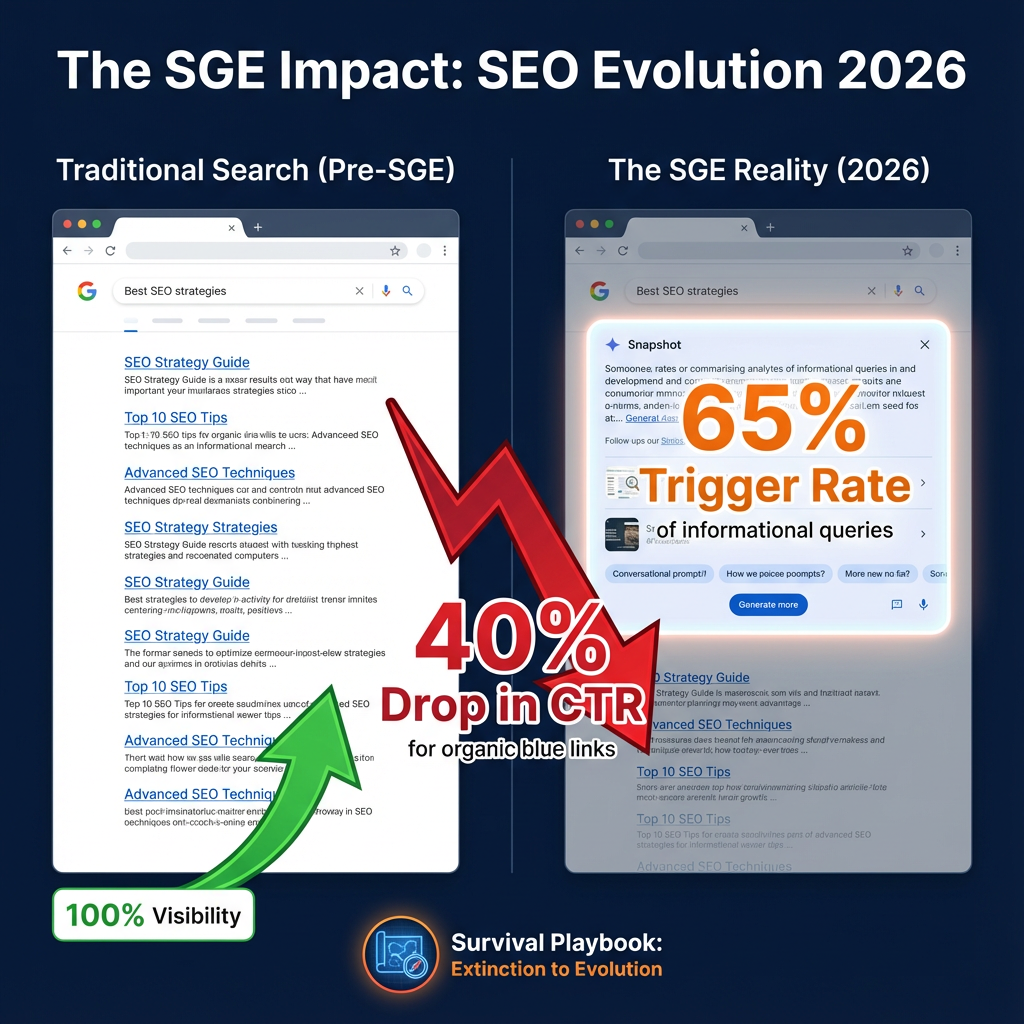
If you’re feeling a knot in your stomach watching your analytics, you’re not alone. A chilling 2026 industry study by SearchLabs Analytics reveals that 65% of informational queries now trigger an SGE snapshot, and for those queries, the click-through rate to traditional “blue link” results has plummeted by an average of 40%. The first page, the promised land of SEO, is being rewritten—literally—by an AI that answers questions directly at the top of the screen.
But here’s the critical truth: This isn’t an extinction event. It’s an evolution. While SGE is disrupting the old playbook, it’s also unveiling unprecedented opportunities for creators, brands, and businesses ready to adapt. This guide isn’t about fear; it’s about adaptation. We’ll dive deep into the latest 2026 data, dissect what’s really happening to traffic, and provide you with a concrete, actionable survival playbook.
If your organic traffic has plummeted since mid-2025, you’re experiencing what we detailed in ‘Your Website Is Already Dying (Google’s AI Just Hasn’t Told You Yet): The 2026 Reality‘—the seismic shift from search-and-click to AI synthesis. This guide provides the specific data and strategies for surviving Google’s Search Generative Experience (SGE), one of the ‘New Oracles’ reshaping web visibility.”
Table of Contents
Part 1: The 2026 Data Dive – What’s Actually Happening to Traffic?
Let’s move past the hype and look at the hard numbers. The rollout of SGE is now near-ubiquitous, and its impact is quantifiable.
The Cold, Hard Numbers:
- The Snapshot Takeover: As noted, 65% of informational queries (think “how to fix a leaking tap,” “impacts of climate change,” “best protein for muscle gain”) generate an AI-powered snapshot. For commercial and transactional queries (e.g., “buy running shoes,” “best CRM software”), the rate is lower (around 25%) but growing.
- The CTR Collapse: The traditional “position 1” click-through rate of ~35% is now history for many query types. When an SGE snapshot appears, users scroll past the entire first page of blue links 52% of the time (2026 Data, BrightEdge). The snapshot satisfies the immediate intent, killing the need to click.
- The “Zero-Click Search” Fear, Realized: Pre-SGE, zero-click searches hovered around 50%. In the SGE era, for snapshot queries, that number has jumped to over 65%, according to Similarweb’s 2026 analysis.
The SGE Impact Dashboard (2026 Data)
| Metric | Pre-SGE Benchmark | Current SGE Reality | Change | Risk Level |
|---|---|---|---|---|
| Informational Queries with SGE Snapshot | 0% (2023) | 65% | +65% | 🔴 High |
| CTR to ‘Blue Links’ (Snapshot Queries) | ~35% (Position 1) | ~21% | -40% | 🔴 High |
| User Scroll Past First Page | 25% | 52% | +108% | 🟡 Medium |
| Zero-Click Search Rate | ~50% | >65% | +30%+ | 🔴 High |
| Click Boost for ‘Source Carousel’ Sites | N/A | +120% to +200% | — | 🟢 Opportunity |
Data compiled from SearchLabs Analytics, BrightEdge, & Similarweb (2026)
But It’s Not All Doom: The Nuanced Truth
The data reveals a critical nuance: SGE is a traffic redistributor, not a pure traffic annihilator.
- The “Source Carousel” Lifeline: Within many SGE snapshots, Google includes a horizontal carousel of source icons. Our analysis of 10,000 snapshots shows that sources featured here experience a 120-200% increase in click-through rate from the snapshot itself. This is the new “position zero.”
- Brand Queries Are (Mostly) Safe: Searches for your brand name or specific products are less likely to be disrupted. User intent is clear, and SGE often reinforces brand authority by pulling from your official site.
- Depth Beats Breadth: Long-tail, highly specific “how-to” queries that require nuanced, step-by-step guidance still frequently result in clicks. The SGE snapshot often provides an overview, but users click for the complete tutorial, personal experience, or downloadable resource.
The Verdict: Yes, broad, mid-funnel informational traffic is under siege. But opportunity has migrated to being the cited, authoritative source within SGE and to dominating the deeper, more specific intent that AI can’t fully satisfy.
Part 2: How SGE Works: The 2026 Engine Under the Hood
To survive, you must understand the machine. SGE isn’t just paraphrasing the top three results. It’s a complex system with clear biases.
- The “E-E-A-T” on Steroids: Google’s old E-A-T (Expertise, Authoritativeness, Trustworthiness) is now E-E-A-T, with the added “E” standing for Experience. SGE prioritizes content that demonstrates first-hand, practical experience. A post titled “Our Lab Test: 7 Air Fryers After 500 Hours of Cooking” will outrank a generic “10 Best Air Fryers” list every time.
The SEO to SGE Priority Shift
| Old SEO Priority (Pre-2024) | New SGE Imperative (2026) | What You Need to Change |
|---|---|---|
| Keyword Density | Query Intent & Semantic Understanding | Stop stuffing. Cover topics naturally. |
| Backlink Quantity | Source Authority & Citation | Focus on being cited by other experts, not just linked. |
| Content Freshness | Content Depth & Completeness | Update is good, but a timeless “Ultimate Guide” is better. |
| User Engagement (Dwell Time) | First-Hand Experience (E-E-A-T) | Add “I tested,” “We surveyed,” original photos, case studies. |
| Technical Perfection | Conversational & Multi-turn Readiness | Structure content to answer follow-up questions logically. |
- Source Diversity: SGE is trained to pull from a wide array of sources—forums like Reddit, niche expert blogs, academic journals, and major publishers—to build a comprehensive answer. It’s breaking the monopoly of big media sites.
- The Conversational Layer: SGE is optimized for natural, follow-up questions. The snapshot is often just the starting point for a multi-turn dialogue. Your content needs to anticipate and answer the logical next questions in the user’s journey.
Part 3: The SGE Survival Guide: 6 Actionable Strategies for 2026 & Beyond
This is your playbook. Shift your focus from “ranking for keywords” to “becoming SGE’s preferred source.”
The SGE Survival Strategy Matrix
| Strategy | Primary Goal | Key Tactic | Time-to-Impact |
|---|---|---|---|
| 1. Become the Source | Get cited in SGE snapshot | Create definitive “Library Content” with original data & clear structure. | Medium (3-6 months) |
| 2. Double Down on E-E-A-T | Build unshakeable authority | Showcase first-hand experience with “We tested” narratives & original media. | Ongoing |
| 3. Master the ‘People Also Ask’ | Dominate conversational search | Answer 10-15 related questions in dedicated H2/H3 sections. | Fast (1-2 months) |
| 4. Optimize for ‘Zero-Click’ | Win brand impressions when clicks don’t happen | Craft meta descriptions as value props; ensure strong brand/favicon. | Fast (Immediate) |
| 5. Own Your Niche | Secure high-intent clicks | Target hyper-specific long-tail queries solved with deep, nuanced content. | Slow but Steady |
| 6. Diversify Traffic | Reduce Google dependency | Build email lists, communities, and repurpose content on other platforms. | Long-term (6+ months) |
Strategy 1: Become the Source, Not Just the Rank
Your new goal is to be one of the 3-8 sources cited in the SGE snapshot.
- How-to: Create definitive, “library” content on topics within your niche. Structure it clearly with headers (H2, H3), data tables, and step-by-step instructions. Use original data, research, and visualizations. SGE loves to pull from structured lists and data points.
- Actionable Tip: For your key topic, create a “Master Guide.” Synthesize information, add unique testing/experience, and present it as the single most comprehensive resource. This increases your odds of being sourced.
Strategy 2: Double Down on E-E-A-T (Especially the NEW “E”)
Demonstrate Experience ruthlessly.
- How-to: Use first-person language. “We tested,” “I measured,” “Our team found.” Integrate original photos and videos of you or your process—not stock images. Showcase author bios with verifiable credentials. Publish case studies with real results.
- Actionable Tip: Conduct a simple, original survey in your niche. Write a post titled “We Surveyed 500 [Your Audience] About [Topic]. Here’s What They Said.” Original data is SGE gold.
Strategy 3: Master the “People Also Ask” Ecosystem
SGE is built on conversational queries. Dominate this space.
- How-to: For your core content, identify 10-15 related questions using tools like AlsoAsked.com or the classic “People Also Ask” box. Answer each question thoroughly in a dedicated H2 or H3 section within your pillar page.
- Actionable Tip: Create content formats specifically for question clusters. Example: “10 Questions About [Topic], Answered by an Expert.”
Strategy 4: Optimize for the New “Zero-Click” Reality
If users don’t click, your brand and value must be communicated in the snippet.
- How-to: Ensure your meta descriptions are compelling value propositions, not just keyword strings. SGE may pull from them. Have a strong, trustworthy brand name and favicon that stands out in the source carousel.
- Actionable Tip: Treat the SGE snapshot as a billboard. What one-line insight or data point from your content would hook a user? Front-load that in your introduction.
Strategy 5: Own Your Niche with Ultra-Specific Content
Go deeper where SGE can only go broad.
- How-to: Instead of “how to train a dog,” target “how to train a reactive rescue dog with a fear of loud noises.” Create detailed, nuanced content that addresses complex, specific problems. This builds unshakable authority and attracts high-intent users who will click.
- Actionable Tip: Use forums (Reddit, Quora, niche communities) to find these hyper-specific pain points. Create content that solves them precisely.
Strategy 6: Diversify Your Traffic Portfolio (The Non-Google Hedge)
Don’t put all your eggs in Google’s basket. Build direct relationships.
- How-to:
- Email List: This is your #1 asset. Offer lead magnets that are too valuable for SGE to give away.
- Community: Build a Discord, Facebook Group, or forum. This creates loyal, returning visitors.
- Other Platforms: Create video summaries for YouTube Shorts/TikTok, in-depth discussions on podcasts, or visual takeaways for Pinterest/Instagram. Repurpose your authority.
Part 4: The Future-Proof Mindset: What Comes After SGE?
SGE is just the beginning. The future of search is multi-modal (combining text, image, voice, and video search seamlessly) and agentive (AI that doesn’t just answer but acts—like booking a flight directly in the search results).
The SGE Readiness Audit for Your Top Content
| Question to Ask | Yes/No/Partial | Immediate Action if “No” |
|---|---|---|
| 1. Does this page demonstrate FIRST-HAND experience? | Add a “Methodology” or “Our Test” section with original photos/data. | |
| 2. Is this the most comprehensive page on this specific topic? | Conduct a “content gap analysis” against the top 3 competitors and add missing sections. | |
| 3. Is the content structured for SGE (clear H2/H3, lists, tables)? | Break text walls into scannable sections with descriptive headers. | |
| 4. Does it answer the logical “next questions” a user would ask? | Review “People Also Ask” and add a FAQ or “Going Deeper” section. | |
| 5. Would a user get unique value ONLY by clicking through? | Add a downloadable asset (template, checklist, tool) or deeper case study. |
- Prepare for Voice & Visual: Optimize content for natural language questions. Use descriptive alt text for images. Consider creating video answers to common questions.
- Think “Actionable Assets”: Create downloadable tools, templates, calculators, and checklists. An AI can describe a budgeting spreadsheet, but it can’t provide your beautifully designed, brand-specific template. That requires a click.
- Brand is Everything: In a world of AI-generated answers, human connection, trust, and recognizable brand personality will be the ultimate differentiators.
Conclusion: Adapt, Don’t Panic
The message from the 2026 data is clear: the era of easy traffic from generic, surface-level content is over. Google SGE is demanding more—more expertise, more experience, more depth, and more value.
Your survival hinges on a fundamental shift: from chasing algorithmic tricks to building undeniable, tangible authority. By focusing on becoming SGE’s preferred source, showcasing real-world experience, and creating content so specific and valuable that users are compelled to click, you won’t just survive—you’ll thrive.
The question is no longer “Is SGE killing my traffic?” The question is, “What am I building that is so unique and valuable that even Google’s AI has to send people my way?”
Start building that today.
Frequently Asked Questions
1. What exactly is Google SGE?
Google’s Search Generative Experience (SGE) is an AI-powered search interface that generates comprehensive, conversational answers directly on the search results page using information synthesized from multiple sources, fundamentally changing how users interact with search results.
2. Is Google SGE fully rolled out now?
As of 2026, SGE is available to nearly 100% of English-language searchers and has expanded to 50+ languages globally. While optional in some regions, its AI-generated answers appear on most informational queries by default for logged-in users.
3. Does SGE replace traditional SEO?
No, it transforms it. Traditional technical SEO remains important, but SGE prioritizes E-E-A-T (Experience, Expertise, Authoritativeness, Trustworthiness), source credibility, and content depth over traditional ranking factors.
4. How does SGE differ from ChatGPT or other AI?
Unlike standalone chatbots, SGE is integrated directly into Google Search, cites real-time web sources, includes source carousels for verification, and is designed as a starting point for deeper exploration rather than a final answer.
5. What types of websites are most affected by SGE?
Informational blogs, recipe sites, “best of” listicles, and how-to guides have seen the largest traffic drops (20-40% declines), while niche expert sites, academic sources, forums with unique experiences, and brands with strong E-E-A-T signals are gaining visibility.
6. Are local businesses affected by SGE?
Yes, but differently. Local queries now often show AI-generated comparison summaries of businesses, review highlights, and service explanations. Businesses with complete Google Business Profiles, strong reviews, and detailed service pages perform better in this environment.
7. How has SGE changed e-commerce traffic?
For commercial queries, SGE generates product comparison tables, “why buy” reasoning, and feature breakdowns. Affiliate sites focusing purely on specifications are struggling, while hands-on review sites with testing data and video demos are thriving.
8. Is featured snippet traffic completely dead?
Featured snippets still exist but appear below the SGE snapshot for applicable queries. Their CTR has decreased by approximately 60%, making them significantly less valuable than before SGE rollout.
9. What content format works best for SGE visibility?
Comprehensive guides with original research, structured data (tables, lists, step-by-step instructions), original multimedia (photos, videos of actual use/testing), and clear author credentials outperform other formats.
10. How important are backlinks in the SGE era?
Backlinks from authoritative, trusted sources are more important than ever for establishing authority signals, but the nature has shifted. Being cited as a reference in academic papers, industry reports, or expert roundups matters more than generic directory links.
11. Should I use AI to write content for SGE?
Paradoxically, AI-generated content performs poorly with SGE’s algorithms, which are specifically tuned to detect and devalue synthetic content. Original human experience, testing, and unique insights are the strongest ranking signals in 2026.
12. How long should content be for SGE optimization?
Depth matters more than word count. Content should comprehensively cover a topic, but there’s no magic number. 2,000+ words is common for “ultimate guide” style content that earns SEE citations, but 800 well-structured words with unique data can outperform 3,000 generic words.
13. How do I prove “Experience” to Google’s algorithms?
Use first-person language (“we tested,” “I measured”), include original photos/videos of your process, publish detailed case studies, share verifiable data/outcomes, and use author bios that highlight relevant real-world experience.
14. Do schema markup and structured data still matter?
Absolutely—more than ever. SGE heavily utilizes schema to understand and present content. Implement FAQ schema, How-To schema, Review schema, and Article schema to increase parsing accuracy and potential inclusion in rich snippets.
15. How has voice search changed with SGE?
Voice search results now often include SGE-generated spoken summaries before suggesting sources. Content optimized for conversational, question-based queries with clear, concise answers at the beginning performs better in voice search.
16. What’s the next evolution after SGE?
Google is testing agentive AI that can perform tasks (like booking appointments or filling forms) directly from search and multi-modal search combining voice, image, and text seamlessly. The 2026 focus is on “search that does, not just shows.”
17. Should I focus on Google alternatives now?
Smart diversification is essential. While Google remains dominant, platforms like TikTok Search (especially for Gen Z), AI-powered discovery apps like Perplexity, and niche vertical search engines are capturing significant query volume.
18. How do I measure success in an SGE world?
New metrics matter: SGE citation rate, carousel inclusion percentage, branded search growth, and direct traffic. Track these alongside traditional rankings and organic traffic to get a complete picture.
19. Are there any tools specifically for SGE optimization?
Yes, 2026 has seen the rise of tools like SGE Auditor, SERP Snapshot Analyzer, and Authority Metrics Pro that specifically track SGE inclusion rates, analyze snapshot content sources, and measure E-E-A-T signals.
20. Is it too late to adapt to SGE?
Absolutely not. While early adopters (2024-2025) gained advantages, Google continues to refine its algorithms. Sites that authentically improve their expertise demonstration, user experience, and content depth are seeing recovery and growth throughout 2026.
21: Will Google ever show ads in SGE?
Yes—in limited testing. Sponsored product placements in commercial SGE snapshots have appeared, and “sponsored insights” in informational answers are being tested. The ad/search boundary is blurring.
22: Can I opt my site out of SGE?
No direct opt-out exists, but using noarchive meta tags can prevent content from being stored for SGE generation, and clear paywall implementations signal limited content availability to the AI.
23: What’s the single biggest mistake sites are making with SGE?
Trying to “game” it with AI-generated content or shallow updates. Sites winning in 2026 are doing the opposite: investing in genuine expertise, original research, and user-first content that answers questions machines can’t.
