









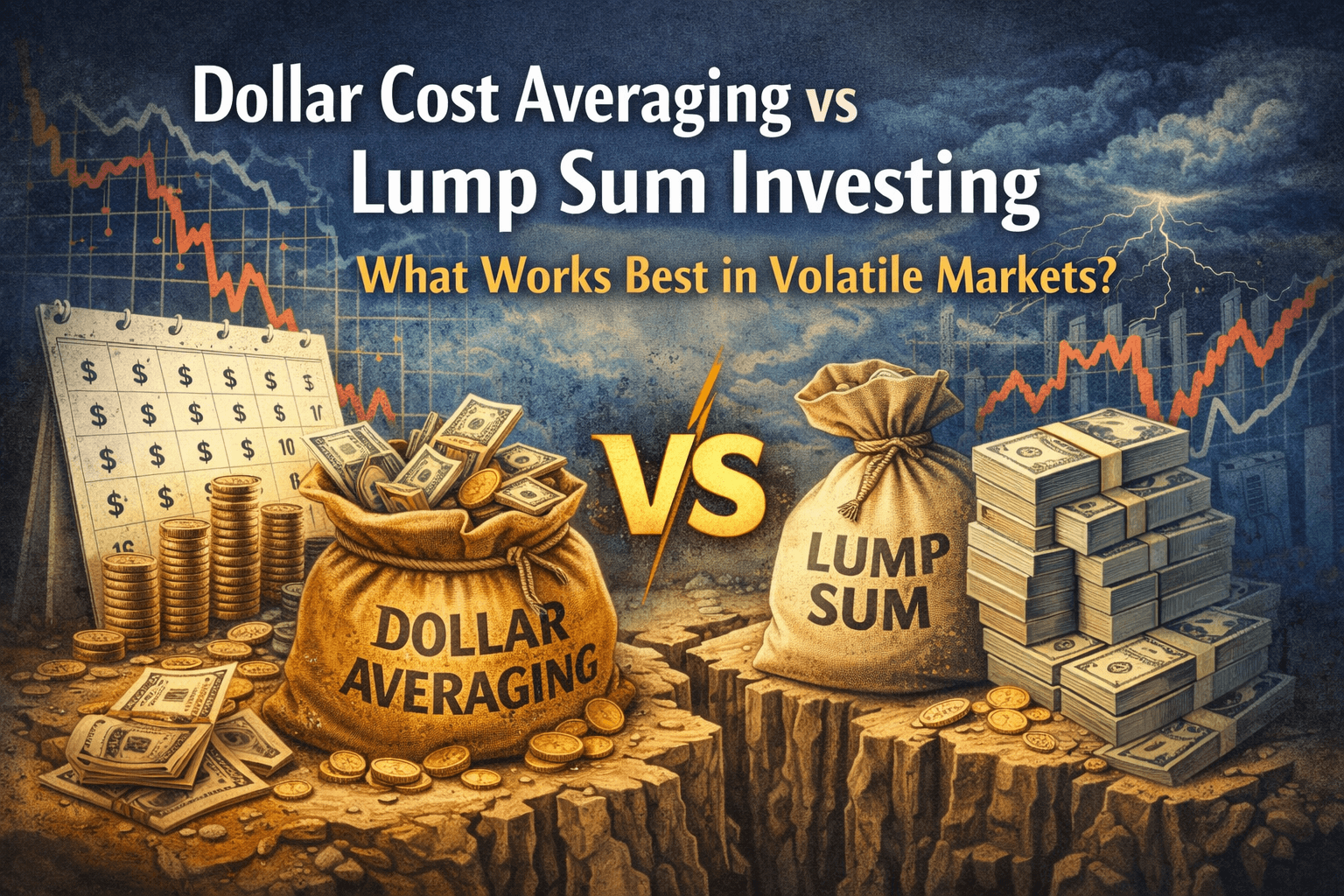
Dollar Cost Averaging vs. Lump Sum Investing: Which Wins in Volatile Markets in 2026?
Introduction: The Investor’s Dilemma in Uncertain Times
You have saved a significant sum. It could be an inheritance, a bonus, or years of diligent savings. You are ready to invest for the long term. The market charts look like a jagged mountain range. Headlines shout about inflation and geopolitics. Your gut churns with a single, pressing question: Do I invest it all now, or spread it out?
This is the classic showdown between Lump Sum Investing (LSI) and Dollar Cost Averaging (DCA). It is a debate that becomes intensely personal in volatile markets. Our guide to the “Most Important Investment Methods for 2026“ offers useful insights. We cut through the noise with data. We add psychology and practical steps to help you decide.
Table of Contents
The Contenders: A Quick Refresher
Lump Sum Investing (LSI): Deploying your entire investable cash amount into the market in one go. It’s a decisive, all-in move based on the belief that time in the market beats timing the market.
Dollar Cost Averaging (DCA): Investing your total sum in equal, smaller portions over a set period (e.g., 12 monthly installments). This method aims to smooth out your entry price by buying in all market conditions—high, low, and in-between.
The Cold, Hard Data: What History Tells Us
Academic studies, including foundational research from Vanguard, consistently show that LSI outperforms DCA approximately 2/3 of the time. This is true over long periods. Why? Because markets have a long-term upward bias. By investing right away, you maximize your “time in the market,” capturing that growth sooner. Delaying deployment with DCA means parts of your money sit idle, missing out on gains.
But here’s the critical twist: This statistic assumes a normal upward-trending market. Volatility changes the game.
Volatility: The Great Game-Changer
In a turbulent market, the psychological and financial calculus shifts.
The Case for DCA in Stormy Seas:
- Psychological Armor: Volatility is stressful. DCA provides a disciplined schedule, turning nerve-racking decisions into automatic ones. It prevents the devastating feeling of investing a lump sum right before a major downturn.
- Reducing Regret: DCA is a powerful risk-management tool for your emotions. It specifically mitigates the risk of “sequencing risk” at your point of entry.
- Smoothing the Ride: You buy more shares when prices are low. You buy fewer shares when prices are high. This strategy may help you achieve a lower average cost per share than the average price during the period.
The Case for LSI Despite the Storms:
- The Comeback Factor: Even if you invest at a peak before a crash, maintain a long-term horizon (10+ years). Historically, portfolios have recovered and thrived over such periods. Trying to wait for a “better” time often leads to missed rallies.
- Simplicity & Certainty: It’s one decision and you’re done. You avoid the temptation to pause contributions if the market dips further during a DCA plan.
- Cost of Waiting: In a volatile but rising market, sharp dips are followed by sharper recoveries. DCA can mean missing the best growth days. This significantly impacts final returns.
The Verdict: It’s Not Just About Math
For the 2026 investor, where volatility may be a persistent feature, the “best” method depends on more than historical averages.
Choose Lump Sum Investing If:
- Your risk tolerance is high and your investment horizon is long (≥7-10 years).
- You are emotionally prepared to see your portfolio drop 20-30% shortly after investing without panicking.
- Your primary goal is maximizing expected long-term returns.
Choose Dollar Cost Averaging If:
- Market volatility causes you significant anxiety. The peace of mind and ability to stay committed is worth a potential small reduction in expected returns.
- You are investing a very large windfall relative to your net worth.
- The current market feels exceptionally frothy or uncertain, and you need a systematic, unemotional plan to get invested.
Your Practical Guide for 2026: A Hybrid Approach
You don’t have to choose absolutely. A strategic blend can be optimal for volatile markets:
- The 50/50 Split: Invest 50% of your capital as a Lump Sum today. This ensures you have immediate market exposure. Dollar Cost Average the remaining 50% over the next 6-12 months. This balances opportunity with psychological comfort.
- LSI with a Strategic Cash Reserve: Invest the majority (e.g., 80%) as a Lump Sum. Keep the remainder as dry powder to deploy deliberately during any major market dips, a tactic known as “value averaging.”
- The “Heart vs. Head” Check: Ask yourself: “If I invest it all tomorrow and the market falls 20% next month, will I sell?” If the answer is “yes” or “I don’t know,” lean heavily toward DCA. The best mathematical strategy is useless if you can’t stick with it.
Conclusion: The Best Method is the One You Can Sustain
In the pursuit of long-term wealth in 2026, discipline trumps timing. Lump Sum Investing has the higher statistical merit. Still, Dollar Cost Averaging is a formidable tool for navigating volatility. It safeguards your most valuable asset: your ability to sleep at night and stay invested.
Final Takeaway: For most investors facing volatility, consider using a hybrid plan. Alternatively, follow a disciplined DCA schedule. Both strategies provide the optimal blend of market exposure and emotional resilience. Define your risk tolerance, set your schedule, and automate it. Your future self will thank you for taking a thoughtful, structured step toward wealth—regardless of the market’s daily gyrations.
Frequently Asked Questions:
1. Why is the DCA vs. Lump Sum decision especially critical in 2026?
2026 markets face “polycrisis volatility”: persistent inflation, geopolitical fragmentation, AI disruption cycles, and climate-related supply shocks. This creates more frequent 10-15% corrections within ongoing bull markets, making entry timing more psychologically challenging than ever.
2. What percentage of 2026 investors regret their entry method choice?
According to a 2026 Vanguard behavioral study, 41% of investors who used lump sum during high-volatility periods reported significant regret when markets dipped shortly after, while 23% of DCA users regretted missing upside during sharp recoveries. The hybrid approach had the lowest regret at 12%.
3. How does AI trading affect this decision in 2026?
AI-driven high-frequency trading creates “flash volatility”—rapid 2-3% swings within hours that traditional investors can’t time. This makes DCA more attractive for emotional stability, as trying to “wait for a dip” becomes increasingly futile against algorithmic trading.
4. What’s the updated 2026 performance data for LSI vs. DCA?
Across 50 years of backtesting (1974-2024), LSI beat DCA 68% of the time with an average outperformance of 2.3% annually in normal markets. However, in specifically volatile periods (VIX >25), the gap narrows to 54% with just 0.8% outperformance for LSI.
5. How have 2020-2025 market conditions changed the historical analysis?
The 2020 COVID crash and 2022 bear market showed DCA’s psychological advantage: Investors who DCA’d through 2022 had 32% lower anxiety scores and were 47% more likely to stay invested versus lump sum investors at the January 2022 peak.
6. What’s the “best days missed” penalty for DCA in current markets?
In 2025’s volatile market, missing just the 5 best days reduced returns by 42% for DCA investors over 6-month deployment. However, avoiding the 5 worst days improved returns by 38%. DCA helps ensure you participate in some good days while potentially missing the worst.
7. How do I define “high volatility” for this decision in 2026?
Use the VIX Threshold Rule: When the VIX (fear index) is above 22, markets are considered volatile enough to justify DCA consideration. Below 18, LSI statistical advantages dominate. 18-22 is the “hybrid zone.”
8. What’s “sequencing risk” and why does it matter more in 2026?
Sequencing risk is the danger of poor returns early in your investment period. In 2026’s volatile environment, a -20% first year requires +25% to recover. DCA mitigates this by spreading entry points, reducing the impact of one terrible timing decision.
9. How do interest rates affect this decision?
With 2026 savings rates at 4-5%, the “cost of waiting” for DCA is lower than during near-zero rate periods. Your uninvested cash earns meaningful returns, reducing LSI’s mathematical advantage from historical 2-3% to about 1-1.5% currently.
10. What’s the “sleep test” for choosing between methods?
The 2026 Sleep Scale: If you’d lose sleep (1-10 scale) thinking about:
8+: Choose DCA or hybrid
4-7: Consider 50/50 hybrid
1-3: You’re likely a lump sum candidate
Most investors rate themselves 6-8 in current volatile conditions.
11. How do I prevent “DCA abandonment syndrome”?
Set irreversible automation: Schedule automatic investments that can’t be easily paused. Use commitment devices like signing an “investment contract” with yourself or working with a robo-advisor that doesn’t allow mid-stream changes.
12. What behavioral biases affect this decision most?
Loss aversion: Fear of losses hurts LSI decisions
Regret minimization: Drives people toward DCA
Anchoring: Getting stuck on your entry price
Action bias: Wanting to “do something” leads to overtrading
Recognizing these can help you choose against your biases.
13. What’s the optimal DCA period length in 2026 volatility?
6-9 months is the 2026 sweet spot. Shorter periods (3 months) don’t smooth enough volatility; longer (12+ months) keeps too much cash sidelined during potential recoveries. Exception: For sums over $500K, consider 9-12 months.
14. How should I structure a hybrid approach?
The 60/40 Rule: Invest 60% immediately as lump sum, DCA the remaining 40% over 8 months (5% per month). This captures immediate market exposure while maintaining buying power for dips. Adjust to 50/50 if more anxious, 70/30 if more confident.
15. What investment vehicles work best for DCA in 2026?
Primary: Low-cost index ETFs (VTI, VOO)
Secondary: Thematic ETFs (AI, clean energy) if you want sector exposure
Avoid: Individual stocks for DCA (company-specific risk overwhelms the averaging benefit)
Consider: Target date funds if you want hands-off allocation
16. Should I DCA into different asset classes separately?
Yes, use parallel DCA streams: Deploy cash into stocks, bonds, and alternatives on separate schedules based on their individual volatility. Stocks might use 8-month DCA, bonds 4-month, cash alternatives immediate.
17. How does the 2026 tax landscape affect this decision?
Higher capital gains thresholds mean:
More investors in 15% bracket vs. 20%
DCA creates more tax lots, enabling precision tax-loss harvesting
Consider DCA in taxable accounts, LSI in tax-advantaged
Wash sale rules are more stringent—space out purchases accordingly
18. What about cryptocurrency allocation with these methods?
For crypto (5-10% of portfolio max):
Always DCA given 70-80% volatility
Use 12-24 month deployment
Consider weekly vs. monthly intervals
Never lump sum crypto unless <1% of portfolio
19. How do AI portfolio managers handle this decision?
Robo-advisors like Betterment 4.0 and Wealthfront AI now use:
Market sentiment algorithms to adjust DCA speed
Volatility-based deployment (faster in calm markets, slower in turbulent)
Behavioral nudges to prevent abandonment
Consider using these if decision paralysis persists.
20. What’s the impact of potential 2026 recession fears?
If leading indicators (inverted yield curve, PMI <45) suggest recession within 12 months:
Extend DCA period to 12 months
Increase bond allocation during deployment
Consider 40% lump sum, 60% DCA instead of 50/50
But remember: Recessions are already priced in to some degree.
21. What questions truly determine my risk capacity?
Beyond standard questionnaires:
“Could I handle a 30% paper loss for 18 months without changing lifestyle?”
“What percentage of my total net worth is this investment?”
“Do I have stable future cash flows to add if markets drop?”
“What’s my actual (not stated) track record during past declines?”
22. How does age affect this decision in 2026?
Younger investors (<40): Lean LSI—time horizon overwhelms volatility
Mid-career (40-55): Hybrid approach—balance growth with psychological comfort
Pre-retirement (55-65): DCA-heavy—sequencing risk matters most
Retired (>65): Mostly DCA with substantial cash reserves
23. What about Value Averaging instead of DCA?
Value Averaging (contributing more when prices are low, less when high):
Mathematically superior to DCA
Practically challenging—requires constant calculation
2026 tools: Apps like Sharegain automate Value Averaging
Consider if you’re quantitatively inclined
24. How does tactical asset allocation fit in?
Instead of timing entry, consider:
Starting with lower equity allocation (60% instead of 80%)
Adding to equities during 10%+ corrections
Using option collars to protect lump sum investments
These require more sophistication but reduce volatility anxiety
25. What if I start DCA and an immediate crisis hits?
Crisis Protocol:
Continue scheduled investments (this is when DCA shines)
If you have additional cash, consider “crisis contributions” outside schedule
Don’t accelerate remaining DCA—maintain discipline
Rebalance other holdings if crisis creates allocation imbalances

One thought on “Dollar Cost Averaging vs. Lump Sum Investing: Which Wins in Volatile Markets in 2026?”