








How Fees, Taxes, and Small Decisions Quietly Destroy Long-Term Wealth in 2026
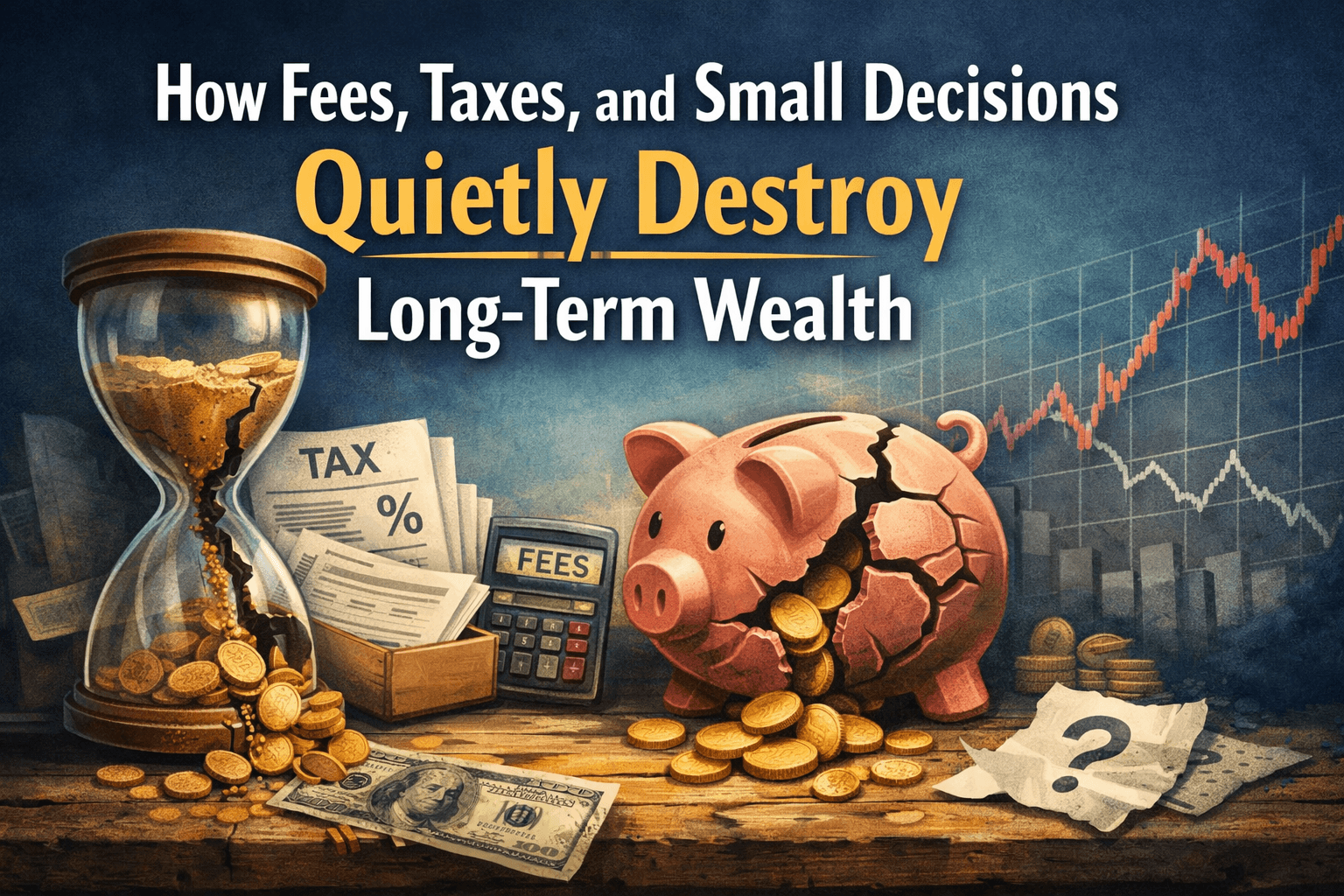
Most investors do not lose money because they picked the wrong stock. They lose money quietly. Not in crashes, scandals, or obvious mistakes that make headlines. Wealth is usually lost through small, invisible leaks that compound against them year after year. A slightly higher fee that seems harmless. A tax event that feels unavoidable. An emotional decision made at the wrong time. A habit that looks insignificant today but quietly erodes decades of progress.
This article explains how wealth is quietly destroyed even when returns look good on paper. More importantly, it explains how to stop those leaks. This is not about chasing higher returns or finding the next winning asset. It is about keeping more of what you already earn.
This is why the most important investment methods for 2026 focus less on returns. They focus more on controlling costs. They also emphasize managing risk and sustaining discipline across market cycles.
Table of Contents
The Silent Enemies of Long-Term Wealth
When people think about investment risk, they imagine volatility. They picture sharp market declines, red charts, recessions, and financial crises. But the most dangerous risks are rarely dramatic. They are subtle and persistent. Fees that quietly deduct themselves. Taxes that interrupt compounding. Decisions that feel small in isolation. Emotional reactions that repeat year after year.
Individually, none of these appear threatening. Together, they quietly drain decades of compounding without drawing attention. By the time the damage becomes visible, time has already done its work against the investor.
Section 1: Fees – The Invisible Tax You Pay Forever
Market losses are temporary. Fees are permanent. A market decline can recover over time, but a fee once paid is gone forever. Every percentage point paid in fees means money that stops compounding. It stops working for you and instead compounds for someone else. The danger is not just the fee itself but the lost growth on that fee over time.
Why Fees Are More Dangerous Than Losses
A market loss is temporary.
A fee is permanent.
Losses can recover. Fees never do.
Every percentage point you pay in fees is money that:
• Stops compounding
• Stops working for you
• Continues compounding for someone else
And the most dangerous part?
Fees are usually expressed as small percentages, which hides their true impact
Fees are often expressed as small percentages, which makes their impact easy to dismiss. But percentages hide scale. What looks like a minor cost today becomes a major drag over decades.
Consider two investors who are similar. Both invest ten thousand dollars per year. Both earn an average return of seven percent before fees. Both stay invested for thirty years. The only difference is cost. One investor pays total annual fees of 0.25 percent, while the other pays 1.25 percent. That one percent difference feels insignificant. Yet after three decades, the lower-cost investor ends with roughly nine hundred forty-five thousand dollars. The higher-cost investor ends with about seven hundred sixty-one thousand dollars. Nearly one hundred eighty-four thousand dollars disappears without drama or bad decisions, simply through quiet erosion.
Most investors focus only on fund expense ratios when thinking about fees. That is only part of the picture. Advisory fees, brokerage, and platform costs add to long-term leakage. Deal costs from frequent trading also contribute. Spread costs in illiquid assets play a role. Embedded charges inside insurance-based products further compound the issue. Each fee feels small. Together, they compound into a significant loss of future wealth.
Fees compound against investors in the same way returns compound for them. The longer the investment horizon, the more destructive this effect becomes. Cost control is not optimization. It is survival.
Section 2: Taxes – The Return You Never Get to Keep
Most investment discussions focus on pre-tax returns. That approach is misleading. Discussing gross returns is like discussing salary without mentioning taxation. What matters is not what you earn, but what you keep.
Why Gross Returns Are Meaningless
Most investment discussions focus on pre-tax returns.
That’s like discussing salary without mentioning tax.
What matters is:
What you keep, not what you earn.
Two investors with identical portfolios can end with vastly different outcomes based solely on tax efficiency.
Taxes quietly destroy compounding by interrupting it. Every unnecessary sale, every short-term gain, and every frequent portfolio rotation resets the compounding clock. Money paid in taxes today never compounds tomorrow. It never earns future returns and never recovers lost time.
Many investors make tax mistakes without realizing it. Frequent trading seems reasonable on its own. This includes ignoring the difference between short-term and long-term gains. Re-balancing without tax awareness also seems reasonable. Holding tax-inefficient assets in taxable accounts and chasing dividends without considering tax drag appear acceptable. Over time, they permanently reduce wealth.
Tax efficiency does not require clever strategies or aggressive planning. It comes from fewer unnecessary transactions, longer holding periods, intentional asset placement, and simplicity. Tax efficiency does not increase market returns. It increases the portion of returns that actually stays with the investor.
Section 3: Small Decisions That Compound Into Big Damage
Investors often obsess over big decisions: which asset to choose, which market to enter, or which fund will perform best. In reality, long-term outcomes are driven by small, repeated behaviors. The difference between success and failure is rarely one dramatic move. It is the accumulation of hundreds of small decisions made consistently over time.
Why Small Choices Matter More Than Big Ones
Investors obsess over big decisions:
• Which asset?
• Which market?
• Which fund?
But outcomes are driven by small repeated behaviors.
The difference between success and failure is rarely one big move.
It is hundreds of small decisions made consistently
Overreacting is one of the most expensive habits. Selling after a market drop feels justified in the moment. Buying after a strong rally seems sensible at the time. Switching strategies mid-cycle can appear rational. Abandoning plans during stress also feels justified in the moment. Over time, these reactions lead to buying high, selling low, missing recoveries, and reducing long-term returns. Behavioral errors often cost more than fees and taxes combined.
Many investors believe they can fix inefficiencies later. They tell themselves a small fee does not matter yet. They assume tax planning can wait. They also believe discipline will come once their portfolio grows.
The Myth of “I’ll Fix It Later”
Many investors tell themselves:
• “This fee doesn’t matter right now”
• “I’ll optimize taxes later”
• “I’ll get disciplined when my portfolio is bigger”
Compounding does not wait for readiness. Every year of delay locks in inefficiency, reduces future flexibility, and shrinks the margin for error.
Section 4: The Hidden Cost of Complexity
Complexity often feels sophisticated, but it quietly leaks wealth. Portfolios with too many funds, overlapping exposures, redundant strategies, and unclear objectives increase fees, taxes, mistakes, and emotional stress. Complexity creates more opportunities for error and more friction in decision-making.
Simple portfolios are not simplistic. They are robust. Simplicity protects compounding by reducing decision fatigue, lowering transaction frequency, improving discipline, and increasing long-term adherence. The most successful portfolios are not impressive or clever. They are durable and easy to maintain.
Why Simplicity Protects Compounding
Simple systems:
• Reduce decision fatigue
• Lower transaction frequency
• Improve discipline
• Increase long-term adherence
The best portfolios are not impressive.
They are durable.
Section 5: Time Is the Multiplier You Can-not Replace
Time amplifies both good and bad decisions. Money lost early is far more expensive than money lost later. A dollar lost in the first year loses decades of potential compounding. In contrast, a dollar lost much later misses far less future growth.
This is why fees, taxes, and bad habits matter most early. Protecting compounding in the early years is one of the highest-impact actions an investor can take. Once time is lost, it can-not be recovered.
Section 6: A Practical Framework to Protect Long-Term Wealth
Protecting long-term wealth is not about perfection. It is about reduction. Practical actions include minimizing costs relentlessly. Reducing tax friction and simplifying portfolios are also crucial. Automating good behavior and protecting discipline help as well. These actions compound in your favor over time.
Low-cost investments keep more money working for you. Longer holding periods preserve compounding. Simpler portfolios reduce mistakes. Automation removes emotion. Discipline prevents self-sabotage. None of these require forecasting markets or predicting trends. They require consistency.
Section 7: Why Most Investors Never Notice the Damage
Quiet wealth destruction has no headlines. Fees are deducted silently. Taxes feel unavoidable. Bad decisions feel rational. There is no alarm bell when compounding is harmed. By the time investors recognize the damage, time is gone, mistakes are irreversible, and opportunity cost is locked in.
This is why awareness matters more than intelligence. Understanding how wealth leaks is often more valuable than finding the next opportunity.
How This Fits Into Timeless Investment Thinking for 2026
In uncertain markets, investors chase better predictions, smarter strategies, and faster reactions. Timeless investing focuses on structure, efficiency, behavior, and longevity. The future will always be uncertain. Leakage is always optional.
The investors who succeed in 2026 and beyond will not be the most clever. They will be the most disciplined at protecting compounding.
Conclusion: Wealth Is Built by What You Keep
Markets will fluctuate. Returns will vary. Cycles will repeat. But fees, taxes, and small decisions operate every year, in every market, without pause. Wealth is not destroyed by one mistake. It is destroyed by un-examined habits.
If you control costs, taxes, and behavior, you do not need perfect timing, perfect forecasts, or constant action. You only need time and consistency.
That is timeless investing.
Frequently Asked Questions
1. What percentage of wealth do most investors lose to “silent leaks” annually?
According to 2026 Vanguard research, the average investor loses 1.8-2.7% annually to invisible leaks—fees, taxes, behavioral mistakes, and inefficiencies. Over 30 years, this consumes 40-60% of potential wealth without a single market crash.
2. Why don’t financial statements show these leaks clearly?
Because leaks are structural, not transactional. Your statement shows “portfolio value” but not “opportunity cost of fees paid” or “tax drag from poor placement.” The average 2026 investor needs to track four separate metrics: gross returns, net returns, after-tax returns, and after-inflation returns to see true damage.
3. What’s the most overlooked wealth destroyer in 2026?
Behavioral tax inefficiency. Investors making “small” portfolio adjustments create $3,500 average annual tax drag per $100K portfolio by resetting holding periods and generating short-term gains. This exceeds most advisory fees yet gets zero attention.
4. What’s the true cost difference between 0.25% and 1.25% fees over 30 years?
The “Fee Multiplier Effect”:
0.25% fee: $10K/year at 7% return = $1.02M after 30 years
1.25% fee: Same contributions = $826K after 30 years
$194,000 lost to fees alone
That 1% difference equals 4.8 years of contributions vanishing.
5. What fees are hidden inside “no-fee” platforms in 2026?
Payment for order flow: $0.001-$0.003 per share (costs $300/year for active trader)
Spread capture: 0.05-0.15% on ETF purchases
Cash sweep rates: Paying you 2% while earning 5% risk-free
Securities lending: Keeping 40-60% of lending revenue
Always check SEC Form CRS for true cost disclosures.
6. How do I calculate total investment cost beyond expense ratios?
Use the 2026 Total Cost Formula:
Fund expense ratio
Advisor/platform fee (if any)
Trading costs (0.10-0.30% for active)
Cash drag (idle cash earning less)
Tax inefficiency cost (0.20-0.80%)
Your all-in cost should be under 0.60% for passive, under 1.25% for active.
7. What’s the most expensive “small fee” investors accept?
Wrap fees on managed accounts. Average 2026 wrap fee: 1.00% on top of underlying fund fees (0.50-0.75%). Investors pay 1.50-1.75% total for often-index-like performance. At $500K, that’s $7,500-$8,750 annually—enough to fund a Roth IRA fully.
8. What’s the tax drag on a typical balanced portfolio in 2026?
The 1% Rule: Most 60/40 portfolios lose 0.80-1.20% annually to taxes through:
Dividend taxes (qualified: 15-20%, non-qualified: ordinary rates)
Bond interest (ordinary income rates)
Capital gains distributions (15-20%)
This means a 7% pre-tax return becomes 5.8-6.2% after-tax.
9. How much do frequent traders lose to taxes annually?
2026 IRS data shows:
Active traders (25+ trades/year): 2.1% average tax drag
Moderate traders (12-24 trades): 1.4% drag
Buy-and-hold (<6 trades): 0.7% drag
Each additional trade costs 0.05-0.10% in potential tax savings lost.
10. What’s the worst tax placement mistake in 2026?
Bonds in taxable accounts. With 2026 yields at 4-5%, a 35% tax bracket investor loses 1.4-1.75% annually to taxes on bond interest. Municipal bonds in taxable yield 3.0-3.5% tax-free, beating taxable bonds’ 2.6-3.25% after-tax.
11. How do qualified dividends affect my tax efficiency?
2026 qualified dividend rates (0%, 15%, 20%) create a “tax alpha” opportunity:
In 12% bracket: 0% tax on qualified dividends
In 22-24% brackets: 15% tax
Over $583,750 (married): 20% tax
Place dividend-paying stocks in taxable if in lower brackets, in retirement accounts if in highest bracket.
12. What small behavior costs investors the most over time?
Portfolio checking frequency. 2026 behavioral research shows:
Daily checkers: 1.8% lower annual returns (overtrading, emotional decisions)
Weekly checkers: 0.9% lower returns
Quarterly checkers: No performance penalty
The act of observing changes the outcome—quantum finance in practice.
13. How much does “just this once” market timing cost?
Missing the 10 best days in a decade reduces returns by ~50%. The average investor attempting to time markets misses 3-4 of these days per decade, costing 1.5-2.0% annually. That’s $300,000+ lost on a $500K portfolio over 20 years.
14. What’s the “snooze button” cost of delaying optimization?
The Delay Tax: Each year you postpone fixing a 1% fee leak costs you 7-10% of that amount in future wealth. Example: $100K portfolio with 1% excess fee:
Fix today: $100K saved over 30 years
Fix in 5 years: $65K saved (35% lost to delay)
Fix in 10 years: $42K saved (58% lost)
15. How many funds is “too many” for optimal efficiency?
The 7±2 Rule: Portfolios with 5-9 funds achieve 95% of diversification benefits. Beyond 12 funds, each additional fund:
Adds 0.05-0.10% in hidden overlap costs
Increases tax complexity (more distributions)
Reduces understanding (leading to mistakes)
The sweet spot: 3-5 index ETFs plus 2-4 satellite positions if desired
16. What’s the overlap cost in “diversified” portfolios?
2026 analysis shows the average “60/40 portfolio” from major advisors has 38-42% overlap—the same stocks appearing across multiple funds. This creates:
Hidden concentration (thinking you’re diversified when you’re not)
Multiple fee layers (paying for the same exposure repeatedly)
Tax inefficiency (multiple dividend payments from same companies)
Use Morningstar Instant X-Ray to check overlap quarterly.
17. How does complexity affect behavioral mistakes?
Each additional decision point increases error probability by 8-12%. A portfolio requiring 10 annual decisions has 60%+ chance of at least one major error annually. Simpler portfolios (<5 decisions/year) reduce this to <25%.
18. What’s the “time value of compounding” in dollar terms?
Each year of early compounding is worth approximately 7-10% of final wealth. Starting at 25 vs. 35 with $500/month:
Start 25: $1.4M at 65 (7% return)
Start 35: $680K at 65
$720,000 difference = $60,000/year delay cost
19. How do I calculate my “personal compounding rate”?
Real After-Tax Return Formula:
Start with portfolio return (e.g., 7%)
Subtract fees (e.g., 0.50%)
Subtract tax drag (e.g., 0.80%)
Subtract inflation (e.g., 2.50%)
Real compounding rate = 7% – 0.50% – 0.80% – 2.50% = 3.20%
This is your true wealth growth rate.
20. What percentage of final wealth comes from years 1-10 vs. years 20-30?
The Front-Loading Effect:
Years 1-10 contributions: Determine 45-55% of final value
Years 20-30 contributions: Determine 15-25% of final value
Early protection matters 2-3x more than later optimization.

One thought on “How Fees, Taxes, and Small Decisions Quietly Destroy Long-Term Wealth in 2026”