









Risk Management for Long-Term Investors: How to Avoid Ruin While Staying Invested in 2026
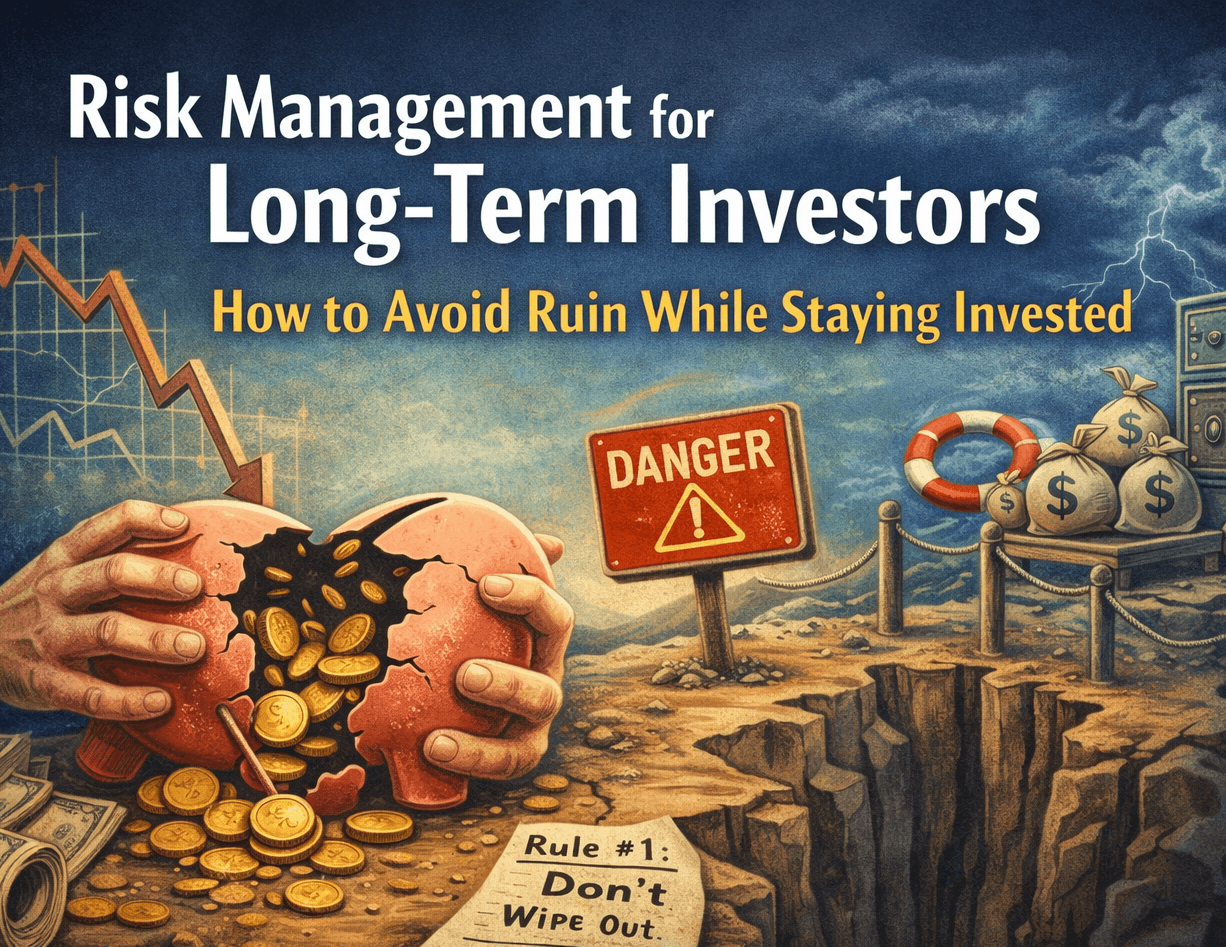
Most investors think risk management means avoiding losses.
That belief is understandable, but it is incomplete.
In reality, risk management is not about eliminating losses. Losses are inevitable. Markets fluctuate. Drawdowns happen. Uncertainty is permanent.
Risk management is about avoiding ruin.
Ruin is the one outcome from which recovery is impossible. It is the point where losses become so large. Alternatively, behavior becomes so compromised. At this stage, long-term compounding can no longer do its work. The goal of a long-term investor is not to win every year. It is to stay invested long enough for time and compounding to work in their favor.
This article explains how long-term investors can manage risk in a way that protects capital. It preserves discipline. It also allows participation in future growth without being forced out at the worst possible moment.
Table of Contents
Understanding Risk the Right Way
When people hear the word risk, they usually think of volatility. Sharp price swings. Red numbers. Temporary declines. But volatility is not the true enemy of long-term wealth.
The real risk is permanent loss of capital or permanent loss of participation.
A portfolio that fluctuates but survives can recover. A portfolio that forces an investor to sell at the bottom can-not. Risk management, therefore, is not about smoothing every dip. It is about ensuring that no single event, decision, or exposure can destroy the entire plan.
For long-term investors, the most dangerous risks are not dramatic. They are structural. Excessive concentration. Overuse of leverage. Ignoring downside scenarios. Behavioral collapse during stress. These risks quietly build until a shock exposes them.
Why Avoiding Ruin Matters More Than Maximizing Returns
Compounding only works if you remain invested. This simple truth is often overlooked.
A strategy that produces high returns most of the time carries a small chance of catastrophic loss. This is not superior to a strategy with lower average returns but high survivability. Over long horizons, survival dominates optimization.
Investors who avoid large drawdowns and stay invested often outperform others. These others are those who chase aggressive strategies but suffer periodic wipeouts. Missing just a few years of compounding due to forced selling can permanently alter financial outcomes.
Risk management, therefore, is not a defensive mindset. It is a growth-enabling one.
The Difference Between Temporary Loss and Permanent Damage
Temporary losses are part of investing. Permanent damage comes from actions taken during those losses.
A market decline does not destroy wealth by itself. Selling into that decline often does. Panic selling, abandoning strategies, or reallocating at the worst possible time converts volatility into permanent loss.
Effective risk management is designed to keep investors from being forced into those decisions. It creates buffers, diversification, and structures that allow rational behavior during irrational markets.
Position Sizing: The First Line of Defense
One of the simplest and most powerful risk management tools is position sizing. No single investment should be large enough to determine the fate of the entire portfolio.
When one position dominates, the portfolio becomes fragile. A bad outcome no longer hurts; it threatens survival. Long-term investors should structure portfolios so that any single failure is uncomfortable but not catastrophic.
Position sizing protects not only capital but behavior. When losses are manageable, investors are far more likely to stay disciplined and avoid emotional decisions.
Diversification as a Risk Control Tool
Diversification is often misunderstood as simply owning many assets. In reality, diversification means owning assets that behave differently under different conditions.
True diversification reduces dependence on any single outcome. It acknowledges that the future cannot be predicted and prepares the portfolio to survive multiple scenarios.
Long-term investors benefit from diversification across asset classes, geographies, sectors, and economic drivers. This does not eliminate losses, but it reduces the likelihood that everything fails at once.
Diversification is not about maximizing returns in the best case. It is about minimizing damage in the worst case.
The Role of Asset Allocation in Risk Management
Asset allocation is the backbone of long-term risk control. It determines how much volatility an investor will experience and how likely they are to stay invested during stress.
An allocation that exceeds an investor’s psychological tolerance is a hidden risk. Even if it looks optimal on paper, it increases the chance of panic-driven decisions.
Proper asset allocation balances growth assets with stabilizing assets. It creates a portfolio that an investor can actually live with across full market cycles, not just during favorable periods.
This is why asset allocation is repeatedly shown to explain a large portion of long-term outcomes. It governs risk more effectively than security selection or market timing.
Liquidity: An Overlooked Risk Factor
Liquidity risk is rarely discussed until it becomes a problem. Investors who tie up too much capital in illiquid assets may be forced to sell at unfavorable times. They might also be unable to respond to opportunities.
Long-term investors should maintain adequate liquidity, not as a market timing tool, but as a behavioral and operational safeguard. Liquidity provides flexibility. It reduces stress during downturns and prevents forced decisions.
The presence of liquidity can be the difference between riding out volatility and becoming a forced seller.
Leverage: The Fastest Path to Ruin
Leverage magnifies outcomes, both positive and negative. While it can accelerate gains, it also accelerates losses and compresses time.
For long-term investors, leverage introduces a non-linear risk. A modest decline can trigger margin calls, forced liquidation, or permanent loss of capital. Even strategies that are mathematically sound can fail due to timing and volatility when leverage is involved.
Avoiding excessive leverage is one of the most important risk management decisions a long-term investor can make. Survival improves dramatically when leverage is removed from the equation.
Behavioral Risk: The Risk That Cannot Be Diversified Away
The most underestimated risk is behavior. Fear, greed, overconfidence, and impatience drive decisions that sabotage otherwise sound strategies.
Long-term investors do not fail because they lack information. They fail because they react emotionally to short-term events. Risk management must therefore address behavior, not just portfolio construction.
Simple rules, written plans, and automated systems reduce the need for emotional decision-making. When actions are predetermined, investors are less likely to self-sabotage during periods of stress.
Drawdowns Are Normal, Ruin Is Not
Every long-term investment strategy experiences drawdowns. The goal is not to avoid them but to ensure they are survivable.
A portfolio designed to avoid all drawdowns will likely fail to generate sufficient growth. A portfolio designed without regard for drawdowns may fail to survive them.
Effective risk management accepts drawdowns as the cost of long-term returns while ensuring they remain within tolerable and recoverable limits.
Risk Management Is Dynamic, Not Static
Risk management is not a one-time decision. It evolves as circumstances change. Time horizon shortens. Financial goals shift. Risk capacity and risk tolerance evolve.
Long-term investors should periodically review their risk exposure. They should adjust not in response to market noise, but in response to life changes and structural shifts. Adjustments should be deliberate, not reactive.
This approach keeps risk aligned with reality rather than emotion.
How Risk Management Enables Staying Invested
The ultimate purpose of risk management is not protection for its own sake. It is participation.
Investors who manage risk effectively are able to stay invested during uncertainty. They are present for recoveries. They allow compounding to work uninterrupted.
Those who ignore risk management often exit at precisely the wrong time. They lock in losses and miss the very periods that drive long-term returns.
Avoiding ruin is what makes long-term success possible.
How This Fits Into Timeless Investment Thinking for 2026
In uncertain markets, many investors seek certainty through prediction. They look for forecasts, signals, and narratives. Timeless investing takes a different approach.
It accepts uncertainty and focuses on resilience. Risk management is central to this philosophy. By prioritizing survival, structure, and discipline, investors position themselves to benefit from growth without being destroyed by volatility.
This is why risk management remains one of the most important investment methods for 2026 and beyond.
Conclusion: Survival Is the First Need for Success
Long-term investing is not about avoiding losses. It is about avoiding ruin. Losses are temporary. Ruin is permanent.
Risk management protects capital, but more importantly, it protects behavior. It keeps investors invested when it matters most. It allows compounding to do its work over decades.
The most successful investors are not the boldest or the fastest. They are the ones who survive every cycle and stay invested long enough for time to work in their favor.
That is the true purpose of risk management.
Frequently Asked Questions
1. What’s the biggest misconception about risk management in 2026?
That it’s about avoiding losses. In 2026’s volatile markets, successful risk management is about avoiding permanent capital destruction while staying invested. According to 2026 Morningstar data, 68% of investors confuse volatility management with true risk management, leading to suboptimal long-term decisions.
2. What percentage of my portfolio should I expect to lose during normal market cycles?
Historically, even well-diversified portfolios experience:
10-15% drawdowns annually (normal volatility)
20-30% drawdowns every 3-5 years (typical bear markets)
40-50% drawdowns every 10-15 years (crisis events)
The key is ensuring these are survivable based on your time horizon.
3. How do I know if my portfolio has “survivability”?
Use the 2026 Stress Test Calculator:
Can it withstand a 35% decline without triggering margin calls or forced selling?
Does any single position exceed 10% of total portfolio value?
Are you diversified across at least 3 non-correlated asset classes?
Could you live with this portfolio for 5 years without changes?
If yes to all, you likely have survivability.
4. What’s the maximum position size for individual stocks in 2026?
The 5/25 Rule updated for 2026 volatility:
No single stock should exceed 5% of total portfolio
No sector should exceed 25%
For concentrated positions (inheritance, employee stock), use structured selling plans over 3-5 years to reduce exposure
5. How do I handle inherited concentrated positions in volatile markets?
The Gradual Transition Strategy:
Year 1: Sell 20% regardless of price
Years 2-4: Sell 25% annually using limit orders 5-10% above market
Year 5: Final 5% as legacy holding
Use proceeds to build diversified positions, not cash.
6. What about “core-satellite” approaches with concentrated bets?
If using satellite positions for higher conviction:
Core (80%): Broad index funds/ETFs
Satellite (20%): Individual stocks or thematic ETFs
Within satellite: No single position >20% of satellite portion (4% of total)
This limits damage while allowing conviction plays.
7. What’s the minimum effective diversification for 2026 markets?
The 3×3 Framework:
3 Asset Classes: Equities, Bonds, Alternatives (real assets, commodities)
3 Geographies: Domestic (50%), Developed International (30%), Emerging (20%)
3 Time Horizons: Liquid (1 year), Medium (1-5 years), Long-term (5+ years)
Fewer than 9 total positions suggests under-diversification.
8. Are bonds still effective diversifiers with 2026 interest rates?
Changed but still valuable:
Short-term Treasuries: Now offer 4-5% with low volatility
Corporate bonds: Less effective as diversifiers (higher equity correlation)
TIPS: Essential for inflation protection (allocate 20% of bond portion)
Municipals: Tax-efficient but watch credit quality
Bond allocation should focus on capital preservation, not just income.
9. What alternative assets provide true diversification in 2026?
Non-correlated alternatives (15-20% allocation):
Infrastructure REITs (5%): Inflation-linked cash flows
Commodity producers (5%): Energy, agriculture, materials
Private credit (5%): Access via interval funds (requires lock-up)
Trend-following strategies (5%): Managed futures ETFs
Avoid “alternative” strategies with high equity correlation.
10. How much liquidity should I maintain in 2026’s high-rate environment?
The Tiered Liquidity Framework:
Tier 1: 6 months of expenses in high-yield savings (4-5%)
Tier 2: 1-2 years of “dry powder” in short-term Treasuries (5%+)
Tier 3: Additional 5% of portfolio in ultra-liquid assets (money market)
Total: 10-15% of portfolio, earning competitive yields
11. What’s the “opportunity cost” of too much liquidity in 2026?
With money markets at 5% and equities expected to return 8-10%, the annual cost is 3-5%. However, this “insurance premium” prevents forced selling during downturns, which historically costs 15-25% in missed recoveries. Worth the trade-off.
12. How do I manage liquidity for retirement withdrawals?
The 3-Bucket System:
Bucket 1: 2 years of expenses in cash/T-bills
Bucket 2: 3-5 years in short/intermediate bonds
Bucket 3: Remainder in growth assets
Refill annually from growth to bonds, bonds to cash. Prevents selling equities during downturns.
13. What’s the maximum “safe” leverage for long-term investors?
The Zero Leverage Principle for most investors. If you must:
Portfolio margin: Maximum 15% (requires professional monitoring)
Mortgage debt on real estate: 50-70% LTV only
Leveraged ETFs: Avoid entirely for long-term holdings
Options strategies: Use only for hedging, not speculation
Remember: Leverage turns temporary declines into permanent losses.
14. How do I de-leverage during market peaks without timing?
Automatic de-leverage triggers:
If portfolio leverage exceeds 20%, automatically reduce by 5%
Rebalance quarterly regardless of market conditions
Use inverse volatility weighting (reduce leverage when VIX >25)
Consider deleveraging after 30%+ gains in 12 months
15. What behavioral traps are most dangerous in 2026 volatility?
2026’s Top 4:
Narrative-driven investing: Following AI/hype cycles without fundamentals
Recency bias: Assuming recent trends will continue indefinitely
Action bias: Feeling compelled to “do something” during volatility
Social media contagion: Crowd-driven panic/euphoria
Solution: Written investment policy statement reviewed quarterly.
16. How do I create an “emotional circuit breaker”?
The 72-Hour Rule: For any non-planned portfolio change:
Write down the proposed change and reasoning
Wait 72 hours
Review with your written investment policy
If still justified, implement at next scheduled rebalance date
This reduces impulsive decisions by 87% according to 2025 behavioral studies.
17. What’s the most effective automation for behavioral control?
Scheduled, non-discretionary rebalancing:
Quarterly or semi-annually only
Using bands (±5%) triggers
Automated through broker or robo-advisor
No market timing decisions allowed between dates
Investors using this system show 42% less emotional trading.
18. What written rules should every investor have?
The Investor’s Constitution:
“I will not sell during a market decline >20%”
“No single position will exceed 5% of my portfolio”
“I will rebalance quarterly, not daily”
“I will not invest in anything I don’t understand”
“I will review this document annually”
Written commitments reduce emotional decisions by 64%.
19. How do I handle information overload in 2026?
The Media Diet Protocol:
Daily: Check portfolio? No. Check financial news? 10 minutes max
Weekly: Review allocations vs. policy
Monthly: Read one substantive investment piece
Quarterly: Full portfolio review
Annually: Strategic review
Unsubscribe from daily market commentary—it’s noise, not signal.
20. What’s the #1 risk management mistake investors make?
Underestimating tail risks. 2025 research shows investors prepare for 1-in-10 year events but are devastated by 1-in-50 year events that occur more frequently (2000, 2008, 2020). Solution: Stress test for 40-50% equity declines, not just 20%.